Social Skills Training for Autism: Helping Children Build Better Communication and Relationships
-
by
Approach
- No Comments on Social Skills Training for Autism: Helping Children Build Better Communication and Relationships
Social skills are an essential part of a child’s overall development, helping them communicate, interact, and build meaningful relationships. For children with Autism Spectrum Disorder (ASD), social interaction can sometimes be challenging due to differences in communication, emotional understanding, and behavior patterns.
Social skills training for autism focuses on helping children develop the ability to connect with others, understand social cues, and participate in group activities with confidence. With structured guidance and consistent practice, children can improve their communication abilities and build stronger relationships in daily life.
This guide explains what social skills are, common challenges in autism, signs a child may need training, benefits of social development programs, and practical activities used to improve social interaction.
Understanding Social Skills in Autism
Social skills are the foundation of human interaction. They help individuals communicate, understand emotions, and respond appropriately in different situations.
Children with autism may find these skills difficult due to differences in how they process social information.
What Are Social Skills and Why Are They Important?
Social skills refer to the ability to interact effectively with others in different settings such as home, school, and community.
They include:
- Communication skills
- Listening and responding
- Understanding emotions
- Sharing and cooperation
- Problem-solving in social situations
These skills are important because they help children build friendships, succeed in school environments, and participate in group activities.
Common Social Challenges Faced by Children with Autism
Children with autism often experience challenges that affect their ability to interact socially.
Common difficulties include:
- Limited eye contact
- Difficulty understanding conversations
- Trouble interpreting facial expressions
- Preference for solitary activities
These challenges may vary in severity but can affect daily interactions and relationships.
How Autism Affects Communication and Interaction
Autism affects how children perceive and respond to social cues. They may find it difficult to understand tone of voice, body language, or emotional expressions.
As a result, communication may appear different, even if the child is interested in interacting. Structured training helps bridge this gap and improve social understanding.
Signs That a Child May Need Social Skills Training
Early identification of social difficulties can help children receive timely support. Social skills training can be beneficial when challenges are consistent and impact daily interactions.
Difficulty Starting or Maintaining Conversations
One of the early signs is difficulty engaging in conversations.
Children may:
- Struggle to start conversations
- Give short or unrelated responses
- Have difficulty maintaining topics
- Avoid verbal interaction
These challenges can affect peer relationships and classroom participation.
Challenges in Understanding Social Cues and Emotions
Understanding non-verbal communication is often difficult for children with autism.
They may struggle with:
- Recognizing facial expressions
- Understanding tone of voice
- Interpreting body language
- Responding to emotions appropriately
Social skills training helps children learn how to recognize and respond to these cues.
Problems with Sharing, Playing, and Group Activities
Group interaction can be challenging due to differences in social awareness.
Children may show:
- Difficulty sharing toys or space
- Limited participation in group play
- Preference for independent activities
- Trouble following group rules
Structured training helps children gradually participate in cooperative activities.
Benefits of Social Skills Training for Children with Autism
Social skills training offers long-term developmental benefits that improve communication, emotional understanding, and social confidence.
It plays a key role in helping children build meaningful relationships.
Improving Communication and Interaction Skills
One of the main benefits is improved communication ability in social settings.
Children learn to:
- Start and maintain conversations
- Respond appropriately to others
- Use verbal and non-verbal communication
- Understand social expectations
This improves interactions at home, school, and in the community.
Building Confidence in Social Situations
As children gain social skills, their confidence increases significantly.
Training helps them:
- Feel comfortable in group settings
- Reduce social anxiety
- Participate in activities more actively
- Express themselves without hesitation
Confidence is an important step toward independence and emotional growth.
Developing Friendships and Emotional Understanding
Social skills training helps children understand emotions and build relationships.
It supports:
- Recognizing feelings in others
- Developing empathy
- Building friendships
- Maintaining positive relationships
These skills improve overall emotional well-being and social integration.
Social Skills Activities Used in Autism Training
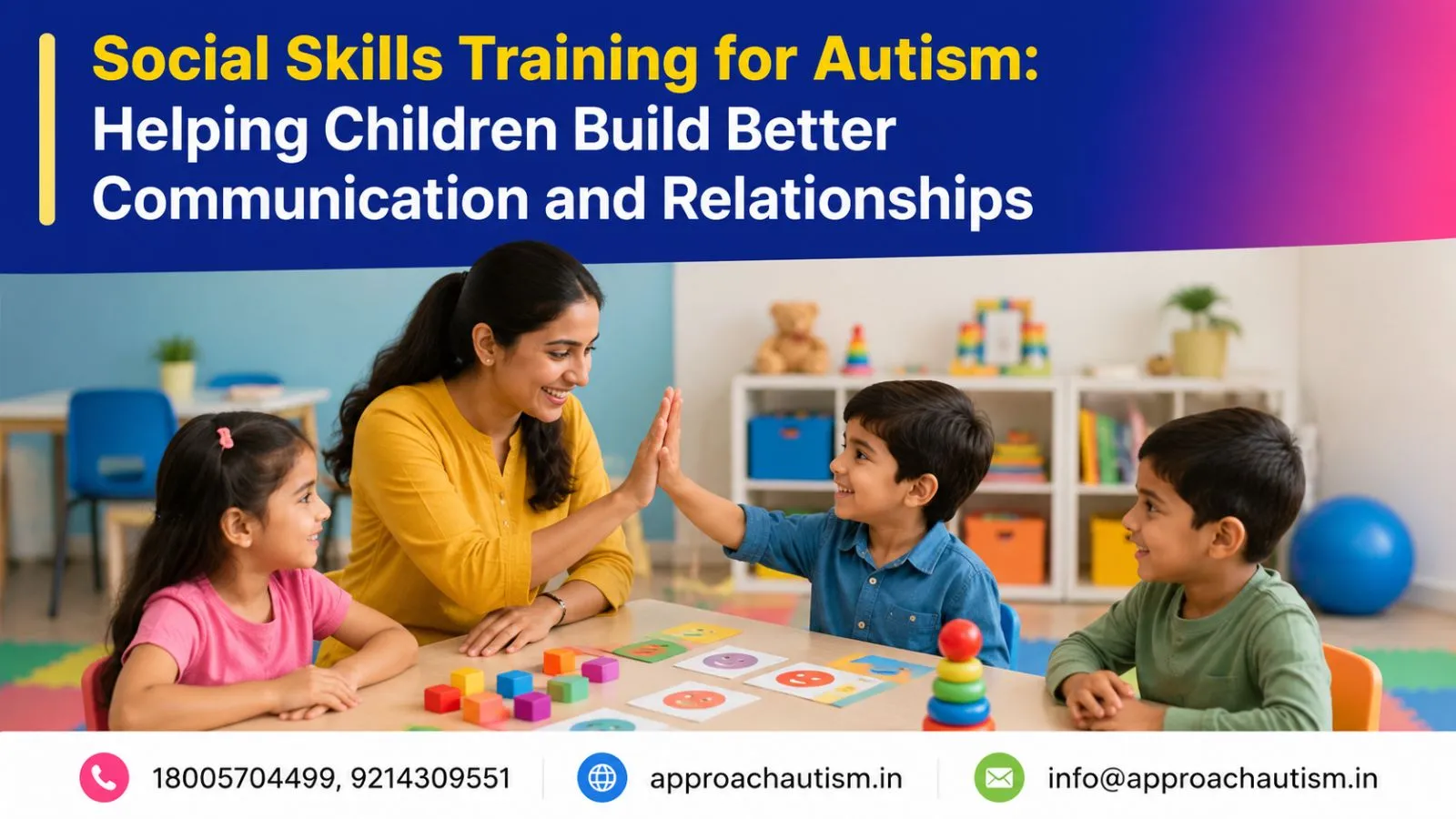
Social skills training uses structured, interactive, and engaging activities to teach communication and interaction skills.
These activities are designed to be practical and easy to understand.
Role Play and Real-Life Communication Activities
Role-playing helps children practice real-world social situations.
Examples include:
- Greeting others
- Ordering food
- Asking for help
- Simulating classroom interactions
These exercises help children understand how to behave in everyday situations.
Group Activities to Improve Social Interaction
Group-based activities encourage cooperation and teamwork.
Examples include:
- Team games
- Group storytelling
- Shared tasks
- Cooperative play sessions
These activities help children learn how to interact with peers in structured environments.
Games and Exercises for Emotional Recognition
Understanding emotions is a key part of social development.
Activities include:
- Emotion matching games
- Facial expression identification
- Story-based emotion learning
- Picture-based recognition exercises
These tools help children identify and respond to emotions more effectively.
How Parents Can Encourage Social Development at Home
Parents play an important role in supporting social development outside therapy sessions. Consistent practice at home helps reinforce learned skills.
Creating Opportunities for Social Practice
Parents can create natural opportunities for social interaction.
This includes:
- Organizing playdates
- Encouraging group activities
- Visiting parks or community spaces
- Promoting peer interaction
These experiences help children practice social skills in real environments.
Encouraging Communication Through Daily Activities
Daily routines can be used to improve communication skills.
Parents can:
- Ask simple questions during activities
- Encourage conversations during meals
- Practice greetings and responses
- Use storytelling during play
This makes social learning part of everyday life.
Supporting Positive Social Behaviors
Positive reinforcement helps children repeat good social behaviors.
Parents can:
- Praise good interactions
- Encourage sharing and cooperation
- Model appropriate social behavior
- Provide gentle guidance when needed
Consistent encouragement helps build long-term social confidence.
Conclusion
Social skills training is an essential support system for children with autism, helping them improve communication, emotional understanding, and interaction abilities. By using structured activities, children learn how to connect with others and build meaningful relationships.
With early support, consistent practice, and parental involvement, children can develop stronger social skills, improved confidence, and better participation in everyday life.
FAQs
1. What is social skills training for autism?
Social skills training is a structured approach that helps children with autism improve communication, interaction, and emotional understanding.
2. Why is social skills training important?
It helps children build relationships, improve communication, and participate more effectively in social situations.
3. At what age can social skills training start?
It can begin in early childhood once social interaction challenges are identified.
4. What activities are used in social skills training?
Activities include role play, group games, storytelling, and emotion recognition exercises.
5. Can parents support social skills development at home?
Yes. Parents can encourage communication, organize social activities, and reinforce positive behaviors at home.