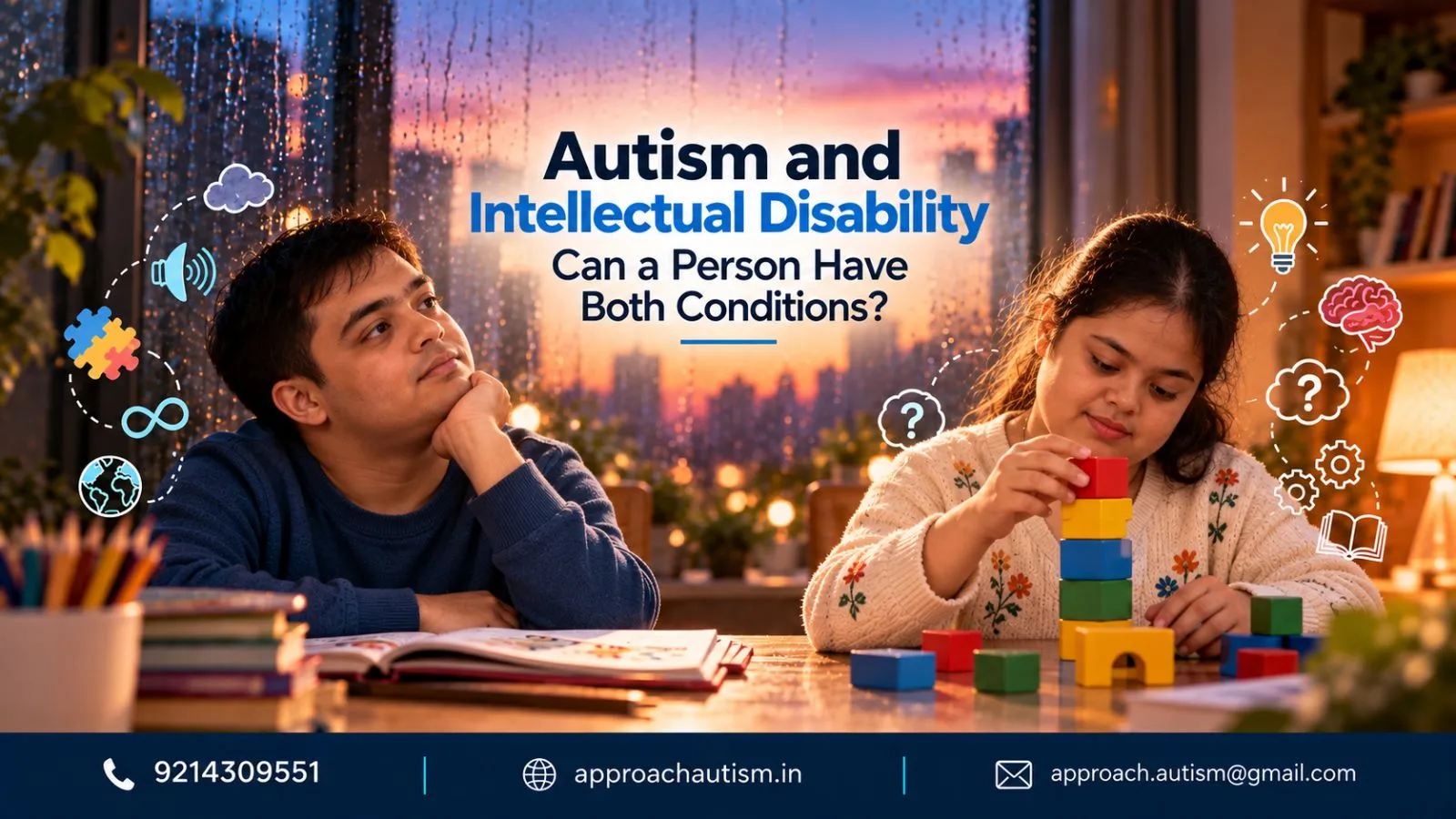
Autism and Intellectual Disability: Can a Person Have Both Conditions?
 Approach
Autism and intellectual disability can occur together, but they are not the same condition. Autism spectrum disorder (ASD) primarily affects social communication, interaction, and patterns of behaviour, while intellectual disability (ID) involves differences in intellectual functioning and adaptive skills. A person can have autism with or without intellectual disability, and a person can have intellectual disability without being autistic.
Understanding this difference is important because each person may have a different combination of strengths, challenges, communication needs, learning abilities, and support requirements. Current evidence continues to emphasise the value of looking beyond a single IQ score and considering everyday functioning, communication, learning, and independence.
What Is Autism Spectrum Disorder?
Autism spectrum disorder is a neurodevelopmental condition associated with differences in social communication and social interaction, along with restricted or repetitive patterns of behaviour, interests, or activities.
Autism can affect people very differently. Some autistic individuals may have significant communication or daily-living support needs, while others may communicate fluently, learn independently, attend college, work, and live with relatively little support.
Autism does not automatically mean that a person has an intellectual disability. Cognitive abilities can range widely among autistic people.
What Is Intellectual Disability?
Intellectual disability is a neurodevelopmental condition involving difficulties with intellectual functioning and adaptive functioning that begin during the developmental period.
Intellectual functioning includes abilities such as:
- Learning and reasoning
- Problem-solving
- Understanding new information
- Planning and decision-making
Adaptive functioning refers to how a person manages everyday demands. It includes conceptual, social, and practical skills such as communication, personal care, managing routines, safety, and participating in community life.
Therefore, intellectual disability is not determined by IQ alone. A comprehensive understanding also considers how a person functions in everyday situations.
Can Autism and Intellectual Disability Occur Together?
Yes. A person can have both autism and intellectual disability.
The two conditions are separate diagnoses, but they can co-occur. CDC surveillance data from 2022 found that among 8-year-old children identified with ASD who had available cognitive data, 39.6% were classified as having intellectual disability. However, 36.1% were classified in the average-or-higher cognitive range, showing why autism should not be equated with intellectual disability.
When both conditions are present, assessment needs to consider whether social-communication difficulties are greater than would be expected from the person’s overall developmental or intellectual level.
Autism vs Intellectual Disability: Understanding the Difference
Autism and intellectual disability can sometimes produce overlapping challenges, but the underlying diagnostic features are different.
Differences in Definition
Autism is identified primarily through differences in social communication and interaction and restricted or repetitive patterns of behaviour.
Intellectual disability is identified through limitations in intellectual functioning and adaptive functioning that begin during the developmental period.
A person can therefore meet the criteria for one condition without meeting the criteria for the other.
Differences in Cognitive Abilities
Autistic people can have a wide range of cognitive abilities. Some may have significant intellectual difficulties, while others may have average or above-average intellectual abilities.
Intellectual disability specifically involves limitations in intellectual functioning. However, the level of support needed cannot be understood from an IQ score alone.
Differences in Social Communication
Social communication differences are central to autism. These may include difficulty understanding social cues, maintaining reciprocal interaction, using or interpreting non-verbal communication, or developing relationships.
A person with intellectual disability may also experience communication difficulties, particularly when their intellectual or language development is affected. However, communication difficulties by themselves do not establish an autism diagnosis.
Differences in Adaptive Functioning
Adaptive functioning describes how effectively a person handles real-life responsibilities.
Someone may have an intellectual disability and require support with communication, money management, personal care, safety, or independent living.
Autistic people can also experience adaptive challenges, even when their intellectual ability is average or higher. This is one reason functional assessment is important when planning support.
How Intellectual Disability May Present Alongside Autism
When autism and intellectual disability occur together, the person’s profile may involve challenges across several developmental areas.
Learning and Problem-Solving Differences
Learning may take longer, particularly when tasks involve abstract concepts, multiple steps, or changes in routine.
Practical teaching methods can be helpful. Breaking activities into smaller steps, using visual supports, repetition, modelling, and hands-on learning can make information easier to understand and apply.
Communication and Language Differences
A person may have delayed speech, limited functional language, difficulty understanding complex instructions, or rely on alternative forms of communication.
Communication should not be judged only by spoken words. Gestures, pictures, communication devices, visual schedules, and other forms of augmentative and alternative communication may help a person express needs and participate more independently.
Daily Living and Adaptive Skills
Some individuals may need support with dressing, hygiene, eating, travelling, money management, household tasks, or following safety routines.
Importantly, these skills can be taught and developed. A person’s current support needs should not automatically be treated as a prediction of their future abilities.
Social and Behavioral Characteristics
Autism may contribute to repetitive behaviours, sensory differences, difficulty with transitions, or challenges in social interaction.
When intellectual disability is also present, it may be harder for the person to communicate discomfort, confusion, frustration, or a need for help. Behaviour should therefore be understood in context rather than simply labelled as “problem behaviour.”
Can Someone Have Autism Without Intellectual Disability?
Yes.
Many autistic individuals do not have an intellectual disability. Some have average or above-average intellectual abilities and may perform strongly in areas such as memory, technology, mathematics, art, music, or specialised interests.
At the same time, an individual with average intellectual ability may still need meaningful support with social communication, sensory regulation, executive functioning, employment, relationships, or independent living.
Can Someone Have Intellectual Disability Without Autism?
Yes.
Intellectual disability can occur without autism. A person may have difficulties with learning, reasoning, communication, and adaptive functioning but may not show the characteristic social-communication and restricted/repetitive behaviour profile required for an autism diagnosis.
This distinction matters because support should be based on the person’s actual developmental profile rather than assuming that one diagnosis explains every difficulty.
How Autism and Intellectual Disability Are Identified
A comprehensive assessment may use information from multiple sources rather than relying on one test.
Developmental History
Professionals may review early developmental milestones, communication, play, social interaction, learning, behaviour, sensory experiences, and changes over time.
Information from parents, caregivers, teachers, and other people who know the individual can be valuable.
Cognitive Assessment
Cognitive testing can help understand reasoning, learning, memory, processing, and problem-solving abilities.
However, test results should be interpreted carefully. Communication differences, anxiety, sensory needs, attention, motivation, and familiarity with testing situations can influence performance.
Adaptive Functioning Assessment
Adaptive functioning looks at what a person can actually do in everyday life.
Areas may include communication, self-care, socialisation, home living, community participation, safety, and practical independence. Current clinical guidance highlights adaptive assessment as an important part of understanding cognitive support needs.
Autism-Specific Evaluation
Autism assessment considers social communication, interaction, restricted or repetitive behaviours, developmental history, and current functioning.
New technology is also being researched in this area. A 2026 study examined computerized adaptive autism assessment and found that a shorter adaptive question set could provide strong predictive performance in the research sample. Such technologies may eventually improve accessibility, but they are not a substitute for appropriate clinical evaluation.
Autism and Intellectual Disability in Children
In children, early identification can help families understand developmental needs and plan appropriate support.
A child with both autism and intellectual disability may benefit from an individualised plan addressing communication, learning, behaviour, sensory needs, self-care, social development, and functional independence.
Digital tools are also being explored for developmental assessment and monitoring. Research has investigated mobile and AI-supported approaches in Indian community settings, but these technologies should be considered supportive tools rather than replacements for trained professionals.
Autism and Intellectual Disability in Adults
The need for support does not end when a person becomes an adult.
Adults with autism and intellectual disability may need continued assistance with employment, vocational skills, communication, relationships, community participation, financial awareness, health routines, and independent living.
A useful adult support plan should focus not only on limitations but also on strengths and meaningful goals. Skills that increase independence can include cooking, travel training, workplace routines, digital skills, shopping, personal care, and decision-making.
Why Distinguishing the Two Conditions Matters
Understanding whether a person has autism, intellectual disability, both, or neither helps professionals and families plan more appropriate support.
For example, an autistic person with average intellectual ability may need support mainly with social communication, sensory regulation, flexibility, or employment skills.
A person with intellectual disability may need greater support with learning, reasoning, adaptive skills, or everyday decision-making.
A person with both conditions may require a more integrated approach.
The goal should not simply be to assign a label. The goal is to understand how the person learns, communicates, functions, and participates in everyday life.
Common Misconceptions About Autism and Intellectual Disability
Myth 1: Autism means intellectual disability.
Not true. Autism occurs across a broad range of intellectual abilities. Current surveillance data includes autistic children with intellectual disability as well as those with average-or-higher cognitive ability.
Myth 2: A person with intellectual disability must be autistic.
Not true. Intellectual disability can occur independently of autism.
Myth 3: IQ tells us everything about a person’s ability.
It does not. Adaptive functioning and real-world skills are also important.
Myth 4: Non-speaking means a person cannot understand.
Speech ability and understanding are not the same thing. Communication should be assessed using multiple methods.
Myth 5: A diagnosis determines a person’s future.
A diagnosis can help identify support needs, but development continues throughout life. Individual skills, environment, education, opportunities, and support can all influence outcomes.
Key Takeaways
Autism and intellectual disability are not the same condition, but they can occur together.
The most important points are:
- Autism does not automatically mean intellectual disability.
- Intellectual disability can occur without autism.
- Some autistic people also have intellectual disability.
- IQ alone does not describe a person’s complete abilities.
- Adaptive functioning is important when understanding support needs.
- Assessment should consider developmental history, cognitive abilities, adaptive functioning, communication, and autism-specific characteristics.
- Children and adults with both conditions can benefit from individualised support focused on communication, daily living, learning, independence, and meaningful participation.
- Emerging digital and AI-assisted assessment technologies may support future developmental evaluation, but professional assessment and individual context remain essential.
Understanding the difference between autism and intellectual disability helps families move away from assumptions and toward personalised support. The focus should ultimately be on the individual’s abilities, needs, communication, independence, and opportunities to participate meaningfully in everyday life.
Frequently Asked Questions
Is autism an intellectual disability?
No. Autism and intellectual disability are separate neurodevelopmental conditions. They can occur together, but autism does not automatically mean intellectual disability.
Can an autistic person have an intellectual disability?
Yes. Autism can co-occur with intellectual disability. Current CDC data shows that among 8-year-old children with ASD who had available cognitive information, 39.6% were classified as having intellectual disability.
Can a person with intellectual disability also be autistic?
Yes. A person can meet diagnostic criteria for both conditions when the characteristics of both are present.
Does autism always affect intelligence?
No. Autism occurs across a broad range of cognitive abilities. Some autistic people have intellectual disability, while others have average or above-average intellectual abilities.
How are autism and intellectual disability different?
Autism is primarily characterised by differences in social communication and interaction together with restricted or repetitive patterns of behaviour. Intellectual disability involves limitations in intellectual functioning and adaptive functioning.