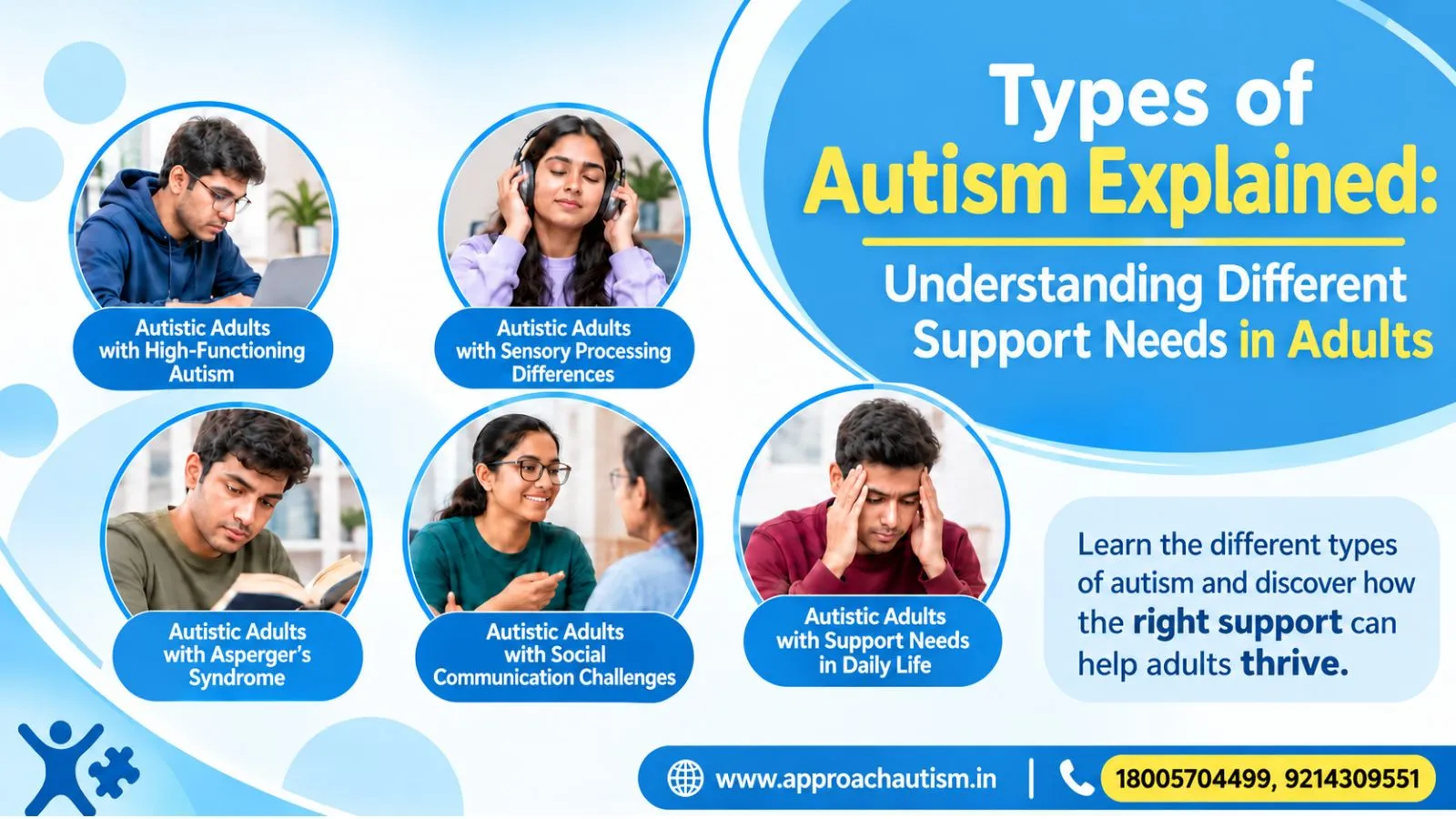
Types of Autism Explained: Understanding Different Support Needs in Adults
-
by
Approach
- No Comments on Types of Autism Explained: Understanding Different Support Needs in Adults
Understanding Autism Support Levels helps families, caregivers and professionals recognise the different ways autism can affect adults. Autism is a spectrum, meaning individuals experience differences in communication, social interaction, behaviour, sensory processing and everyday independence. Some autistic adults manage most activities independently, while others require regular or substantial assistance with daily responsibilities. Understanding the types of autism in adults is not about placing individuals into fixed categories. It is about recognising their abilities, identifying their individual support needs and creating opportunities for meaningful participation, confidence and independence.
What Are the Different Types of Autism Spectrum Disorder?
Autism Spectrum Disorder (ASD) is a lifelong neurodevelopmental condition that affects how individuals communicate, interact with others, process information and experience their surroundings. The term spectrum reflects the wide variation in characteristics, abilities and support requirements among autistic individuals.
Previously, different diagnostic terms such as Asperger’s syndrome, autistic disorder and pervasive developmental disorder were used to describe particular presentations. Current diagnostic frameworks combine these conditions under Autism Spectrum Disorder rather than treating them as separate autism types.
For adults, understanding autism involves looking beyond a diagnostic label. Two individuals with the same diagnosis may have very different communication abilities, learning preferences, sensory experiences and daily living skills.
Therefore, understanding individual strengths and challenges is more useful than assuming that everyone with autism experiences the same difficulties.
Understanding the Three Autism Support Levels in Adults
The diagnostic framework describes three autism support levels: Level 1, Level 2 and Level 3. These classifications indicate the degree of support an individual may require in social communication and restricted or repetitive behaviours.
Level 1 Autism: Requiring Support
Level 1 autism describes individuals who require support, particularly when navigating social communication, changing routines and unfamiliar situations.
Some adults may communicate verbally, participate in education or employment and manage many daily activities independently. However, they may experience difficulty understanding indirect communication, maintaining social relationships or adapting to unexpected changes.
Common support requirements may include:
- Guidance with social communication and interactions.
- Help managing unexpected changes and transitions.
- Workplace adjustments and structured instructions.
- Support with planning, organisation and responsibilities.
- Strategies for managing sensory challenges.
Adults at this level may benefit from predictable routines, clear communication and practical guidance. Their abilities should be recognised alongside areas where assistance is helpful.
Level 2 Autism: Requiring Substantial Support
Level 2 autism describes individuals who require substantial support with communication, social interaction and everyday activities.
Some adults may use spoken language, while others communicate through alternative methods or require additional time to express their needs. Social situations and unexpected changes may create considerable difficulties.
Support may involve:
- Regular assistance with daily routines.
- Structured communication support.
- Guidance with household and personal responsibilities.
- Help understanding instructions and completing tasks.
- Support with community participation and employment preparation.
Consistent guidance and practical learning opportunities can help individuals develop useful skills. The level of assistance should reflect their abilities and changing circumstances.
Level 3 Autism: Requiring Very Substantial Support
Level 3 autism describes individuals who require very substantial support because differences in communication and behavioural flexibility can significantly affect everyday functioning.
Some adults may have limited spoken communication or require alternative communication methods. They may need ongoing assistance with personal care, safety, daily routines and participation in community activities.
Support can include:
- Assistance with personal hygiene and self-care.
- Structured supervision and daily routines.
- Individualised communication approaches.
- Help with household and community activities.
- Consistent support in different environments.
The objective is to promote dignity, comfort, participation and achievable independence wherever possible. Requiring substantial assistance does not mean an individual cannot learn new skills or experience meaningful growth.
How Autism Support Needs Differ From Person to Person
Autism does not affect every individual in the same way. Support needs depend on communication abilities, sensory experiences, learning preferences, daily living skills and environmental circumstances.
Social Communication and Interaction Differences
Some autistic adults find conversations, non-verbal communication, social expectations and relationship-building challenging. Others communicate comfortably but may prefer direct language and predictable interactions.
Support can include communication practice, social learning opportunities and guidance with everyday interactions. Visual instructions, written communication and additional processing time may also be helpful.
Sensory Sensitivities and Behavioral Patterns
Sensory experiences may influence how adults respond to sounds, lighting, textures, smells and crowded environments. Some individuals prefer predictable activities, while others seek particular sensory experiences.
Changes in routines may also cause discomfort. Understanding these patterns helps families and professionals make appropriate adjustments rather than interpreting every response as intentional difficulty.
Daily Living Skills and Independence
Daily living skills include personal hygiene, dressing, preparing meals, managing money, organising belongings and following routines.
Some adults perform these activities independently, while others require reminders, demonstrations or direct assistance. Individualised training can help develop practical abilities through repetition, structured guidance and real-life activities.
Are Asperger’s Syndrome and Other Autism Types Still Diagnosed Separately?
Asperger’s syndrome was previously used as a separate diagnostic category for individuals who experienced autistic characteristics without the same recognised pattern of language or intellectual development associated with some other historical diagnoses.
Under current DSM-5 and DSM-5-TR diagnostic frameworks, Asperger’s syndrome is included within Autism Spectrum Disorder rather than diagnosed as a separate autism subtype.
People previously diagnosed with Asperger’s syndrome may continue using the term to describe their identity or personal experience. However, current clinical diagnosis generally uses the broader autism spectrum classification.
Understanding this change helps families avoid confusion when reading older medical reports or discussing different autism classifications.
How Autism Support Needs Can Change Throughout Adulthood
Autism is lifelong, but an individual’s abilities, circumstances and support requirements can change throughout adulthood.
Life transitions such as entering employment, moving into independent accommodation, developing relationships or managing household responsibilities may introduce new challenges.
Some individuals develop stronger communication, organisational and self-care skills through practice and appropriate support. Others may require additional assistance during periods of stress, health changes or major transitions.
Support should therefore be reviewed regularly. A person’s earlier diagnosis or support classification should not become a permanent assumption about what they can achieve.
Common Challenges Faced by Autistic Adults With Different Support Needs
Autistic adults may encounter barriers in workplaces, social environments and community activities. These challenges can vary depending on personal strengths, environmental accessibility and available assistance.
Employment and Workplace Support
Employment can provide financial opportunities, confidence, routine and social participation. However, interviews, workplace communication, changing instructions and unfamiliar environments may create difficulties.
Useful workplace support includes clear instructions, structured responsibilities, predictable schedules and suitable communication methods.
Vocational training and employment readiness activities can help adults practise task completion, time management, teamwork and workplace behaviour.
Relationships and Community Participation
Building relationships and participating in community activities may require additional support for some individuals.
Social expectations, communication differences and unfamiliar situations can create barriers. Inclusive activities, respectful communication and opportunities to practise social skills can encourage participation.
Families and communities should focus on creating environments where autistic adults feel respected and included.
How Families and Caregivers Can Support Autistic Adults
Families and caregivers play an important role in helping autistic adults develop confidence and practical independence.
Support should begin with understanding the individual’s abilities, preferences, communication style and personal goals. Rather than making every decision on their behalf, families should encourage participation in everyday choices.
Helpful approaches include:
- Establishing predictable daily routines.
- Teaching personal hygiene and self-care skills.
- Using clear instructions and visual reminders.
- Encouraging communication and social interaction.
- Providing opportunities for household responsibilities.
- Supporting vocational learning and employment preparation.
- Respecting sensory preferences and personal boundaries.
Families should also recognise the importance of patience and consistent encouragement. Progress may happen gradually, and different individuals may require different teaching methods.
Why Personalized Support Matters More Than Autism Labels
Autism support levels provide a general description of support requirements, but they cannot explain everything about an individual’s abilities, personality, interests or potential.
One adult may need assistance with communication but manage personal care independently. Another may communicate confidently but require substantial help with planning, household responsibilities or safety.
Personalised support focuses on what an individual can do, what they want to learn and where assistance makes participation easier.
Approach Autism Society follows a practical skill-development approach through life-skills training, employment readiness and residential independent-living support. Its programs focus on personal care, communication, household activities, responsibility and opportunities for greater participation.
The goal should not simply be to improve a classification or reduce visible autistic characteristics. Meaningful support should help individuals develop useful abilities, experience dignity and participate in everyday life according to their potential.
Conclusion: Understanding Autism Beyond Types and Levels
Understanding different levels of autism spectrum disorder helps families recognise that autistic adults have varied communication abilities, learning preferences and daily support requirements. Level 1, Level 2 and Level 3 describe different degrees of support rather than fixed measures of intelligence, personality or potential.
Every autistic adult deserves opportunities to learn, develop practical skills and participate meaningfully in society. With individualised guidance, accessible environments, family involvement and appropriate vocational opportunities, adults can work towards greater confidence and independence.
Families exploring practical development opportunities can learn more about the programs offered by Approach Autism Society, which works to support autistic individuals through life-skills development, independent living training and employment initiatives.
Frequently Asked Questions (FAQs)
1. What are the three levels of autism in adults?
The three support levels are Level 1 (requiring support), Level 2 (requiring substantial support) and Level 3 (requiring very substantial support). They describe support requirements in social communication and restricted or repetitive behaviours.
2. What is the difference between Level 1, Level 2, and Level 3 autism?
The primary difference is the degree of support required. Level 1 generally involves support needs, Level 2 involves substantial support, and Level 3 involves very substantial support across important areas of functioning.
3. Can an autistic adult’s support needs change over time?
Yes. Support needs may change with experience, skill development, health, living arrangements, employment and environmental circumstances. Regularly reviewing individual needs helps ensure appropriate assistance.
4. Is Asperger’s syndrome still considered a separate type of autism?
No. Current DSM-5-TR diagnostic criteria include Asperger’s syndrome within Autism Spectrum Disorder rather than recognising it as a separate diagnostic category.
5. Can adults with different autism support levels live independently?
Some autistic adults live independently, while others benefit from supported living or ongoing assistance. Independence depends on individual abilities, practical skills, personal circumstances and available support.