Autistic Body Language: How Communication Can Look Different in Autism
 Approach
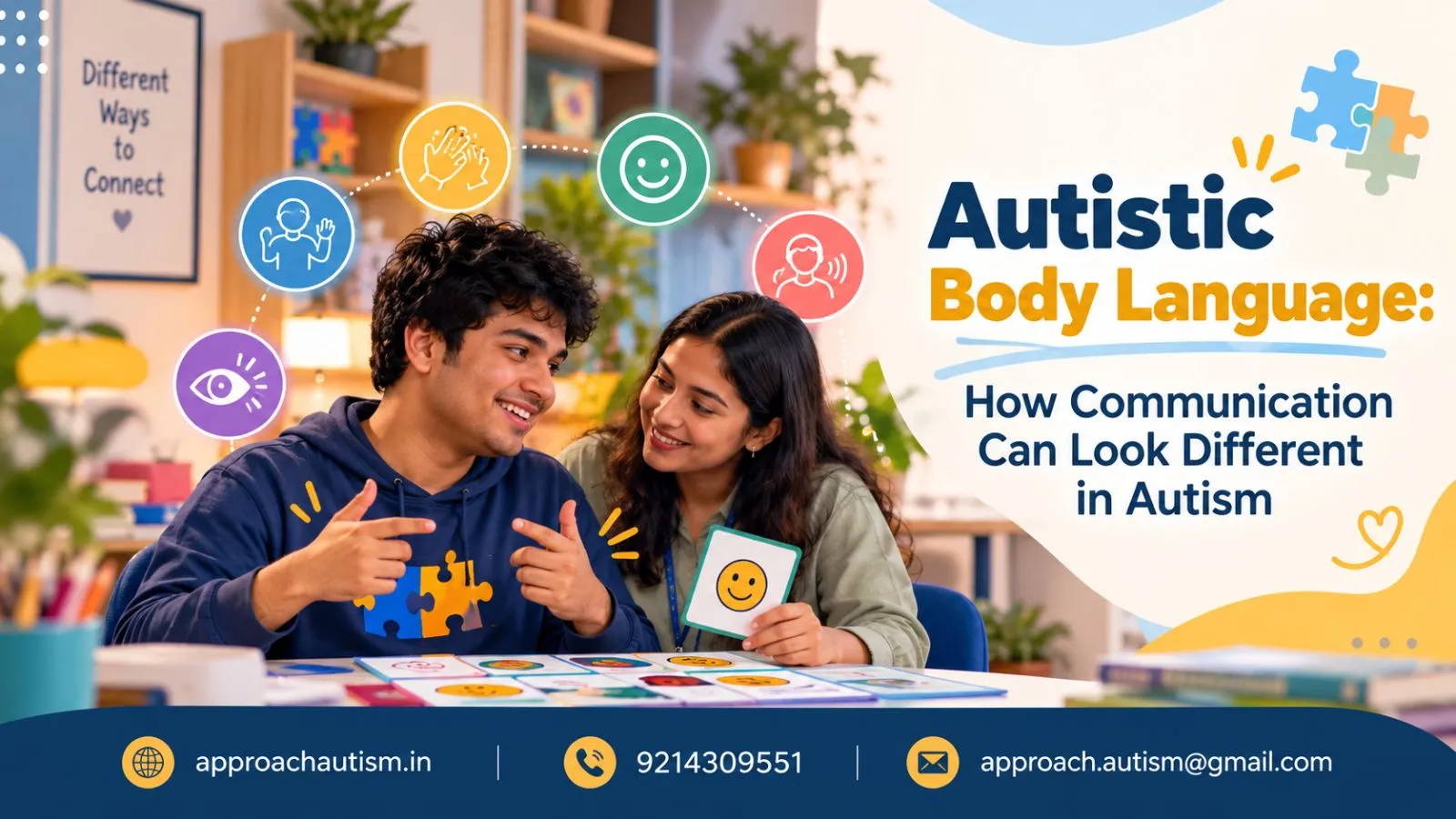
Autistic body language can differ from the nonverbal communication patterns many people expect in everyday interactions. Some autistic people use fewer facial expressions, make less eye contact, or communicate through gestures and movements in different ways. Others express themselves through body language that may not be immediately understood by non-autistic people.
Body language includes facial expressions, gestures, posture, eye contact, and personal space. These signals can support spoken communication, but they do not have the same meaning for everyone.
Understanding autism and body language helps parents, teachers, caregivers, and colleagues avoid misunderstandings. An autistic person who looks away, moves their hands repeatedly, or shows a neutral facial expression may still be interested, happy, upset, or engaged. The best approach is to understand the individual rather than assume what their body language means.
What Is Autistic Body Language?
How Can Autism Affect Body Language?
Autism can influence how a person expresses themselves and interprets other people’s nonverbal signals. Some autistic people may use facial expressions or gestures differently, while others may find certain social signals difficult to interpret in unfamiliar situations.
For example, an autistic person might look away while listening, use fewer conventional gestures, or express excitement through repetitive movements. Another person may use eye contact, facial expressions, and gestures comfortably but communicate differently in other situations.
These differences are not identical for every autistic person. Communication can also change depending on sensory demands, familiarity, fatigue, stress, and the environment.
Autism involves a broader developmental profile that may include social-communication differences and restricted or repetitive behaviours or interests. Body language is one possible part of this profile, not a standalone way to identify autism.
Why Can Body Language Be Different in Autism?
Several factors may contribute to differences in nonverbal communication.
- Sensory and processing differences: Busy environments, noise, movement, and multiple social signals can make interactions more demanding.
- Social communication differences: A person may use gestures, facial expressions, or eye contact differently from what others expect.
- Unspoken social rules: Conventions such as how long to maintain eye contact or when to gesture can be confusing or tiring.
- Individual preferences: Some people naturally express emotions less visibly, while others communicate through movement, words, or alternative methods.
These factors do not mean every autistic person has difficulty understanding communication. Some recognise certain signals easily but find others confusing. Others may understand a social situation but choose not to use conventional body language.
Common Body Language Differences in Autism
Facial Expressions and Gestures
Some autistic people show facial expressions less frequently or in ways that differ from common social expectations. Their expressions may not always match what another person expects to see in a particular situation.
For example, a person might feel excited without displaying a broad smile. Someone else may show happiness through movement, repeated words, or an animated voice rather than through facial expression alone.
Gestures can vary too. Some autistic people point, wave, nod, and use hand movements naturally. Others may use fewer conventional gestures or rely more on spoken explanations.
A difference in expression does not automatically indicate a difference in emotion. It is important to consider what the person says, does, and communicates in other ways rather than relying only on their face.
Posture, Personal Space and Eye Contact
Posture and body position can also differ. An autistic person might turn away from a speaker, move while listening, or prefer a particular physical position during conversations. These behaviours can reflect comfort, sensory needs, or concentration rather than disinterest.
Personal space preferences vary between individuals. Some people prefer more distance, while others may stand closer than expected. Clear, respectful explanations about boundaries can help everyone feel comfortable without shaming the person.
Eye contact is another commonly discussed difference. Some autistic people find direct gaze uncomfortable or distracting. Others make eye contact frequently or use it differently depending on the situation.
Looking away does not necessarily mean someone is ignoring a conversation. In some cases, it helps the person concentrate on spoken information. Eye contact should not be treated as a measure of honesty, empathy, intelligence, or attention.
Repetitive Movements and Stimming
Stimming refers to repetitive movements or actions that may help an autistic person regulate sensory experiences, manage emotions, express excitement, or maintain focus. Examples include hand-flapping, rocking, finger movements, or repeating certain actions.
These movements can serve a meaningful purpose. For instance, a child may flap their hands when excited, while an adult may move their fingers to manage stress or concentrate during a meeting.
Stimming should not automatically be interpreted as distress or inappropriate behaviour. If a movement is safe and helps the person regulate, there may be no reason to stop it.
If a behaviour causes injury or creates a safety concern, the priority should be understanding its purpose and finding a safe, supportive alternative where needed. The aim is wellbeing and communication, not simply making someone appear more typical.
How Autistic Body Language Can Be Misinterpreted
Misunderstandings can happen when people assume that everyone communicates using the same nonverbal signals.
A neutral expression may be mistaken for anger. Looking away may be interpreted as inattention. Repetitive movements may be viewed as disruptive, even when they help the person remain calm or focused.
Research also suggests that autistic and non-autistic people may differ in how they produce and interpret facial expressions. This means communication difficulties can arise between people with different communication styles, rather than being solely a problem for the autistic person.
Instead of guessing, ask clear and respectful questions. For example, you might say, “Would you prefer a break?” or “Would it help if I explained that another way?” Direct communication can reduce uncertainty and prevent unnecessary conflict.
Supporting Autistic Body Language and Communication
Understanding Autistic Children, Teenagers and Adults
Autistic body language may look different across ages and situations. In children, parents may notice differences in gestures, facial expressions, eye contact, or shared attention alongside other developmental characteristics.
If several developmental concerns are present, a qualified professional can assess the child’s overall communication and development. A single behaviour should not be used to diagnose autism.
Autistic teenagers may become more aware of social expectations at school or among peers. They may try to copy expected expressions or gestures to avoid standing out. Support should help them communicate comfortably and understand social situations without suggesting that their natural expression is wrong.
Autistic adults may have developed strategies for navigating workplaces, relationships, and social gatherings. Some use familiar gestures and expressions comfortably, while others prefer direct language, written communication, or more time to process conversations.
Every person’s needs are different. Support should reflect their preferences, strengths, and everyday experiences.
How Parents and Caregivers Can Better Understand Body Language
Parents and caregivers can improve communication by observing patterns over time instead of judging one expression or movement.
Helpful approaches include:
- Use clear language: Say what you mean rather than relying on hints or implied instructions.
- Allow processing time: Give the person time to understand information and respond.
- Respect sensory preferences: Consider whether noise, crowds, lighting, or close physical proximity make communication harder.
- Ask rather than assume: If you are unsure how someone feels, ask them directly in an accessible way.
- Accept different ways of showing attention: Do not insist on eye contact if it makes listening more difficult.
- Recognise individual signals: Learn the gestures, expressions, movements, and words the person uses to communicate.
For children, visual supports, predictable routines, and simple explanations may help make social situations easier to understand. Adults may benefit from written instructions, clear meeting expectations, or the opportunity to communicate without pressure.
Families looking for guidance on individual communication needs can explore resources through an autism support centre in Jaipur.
Communication Beyond Conventional Body Language
Body language is only one part of communication. Autistic people may communicate through spoken words, gestures, writing, pictures, communication boards, or augmentative and alternative communication (AAC) tools.
Some people use several methods depending on the situation. Someone who speaks fluently may still find written communication easier when stressed. Another person may use pictures or a communication device to express needs, preferences, and feelings.
Communication methods should be respected according to the individual’s needs. Spoken language is not the only meaningful way to express understanding or make choices.
It is also important to challenge common myths about autism and body language:
- Myth: Autistic people do not understand emotions. Emotional understanding and expression vary between individuals. Body language alone cannot tell you what someone understands or feels.
- Myth: Limited facial expressions mean a lack of feelings. A person’s visible expression may not reflect the intensity of their internal emotions.
- Myth: Different body language means poor communication. Communication can be effective even when it does not follow conventional social expectations.
The goal is mutual understanding. When people explain expectations clearly, remain open to different communication styles, and respect individual preferences, interactions can become more comfortable and meaningful.
Conclusion
Autistic body language can include differences in facial expressions, gestures, posture, eye contact, and repetitive movements. However, there is no single body language pattern shared by every autistic person.
Looking away does not automatically mean disinterest, and a neutral expression does not mean a person lacks emotion. Similarly, stimming may help with sensory regulation or emotional expression rather than indicate a problem.
The most supportive approach is to consider the whole person, ask rather than assume, and recognise different ways of communicating. By respecting individual preferences and making communication more accessible, families, educators, and communities can build stronger understanding and more inclusive relationships.