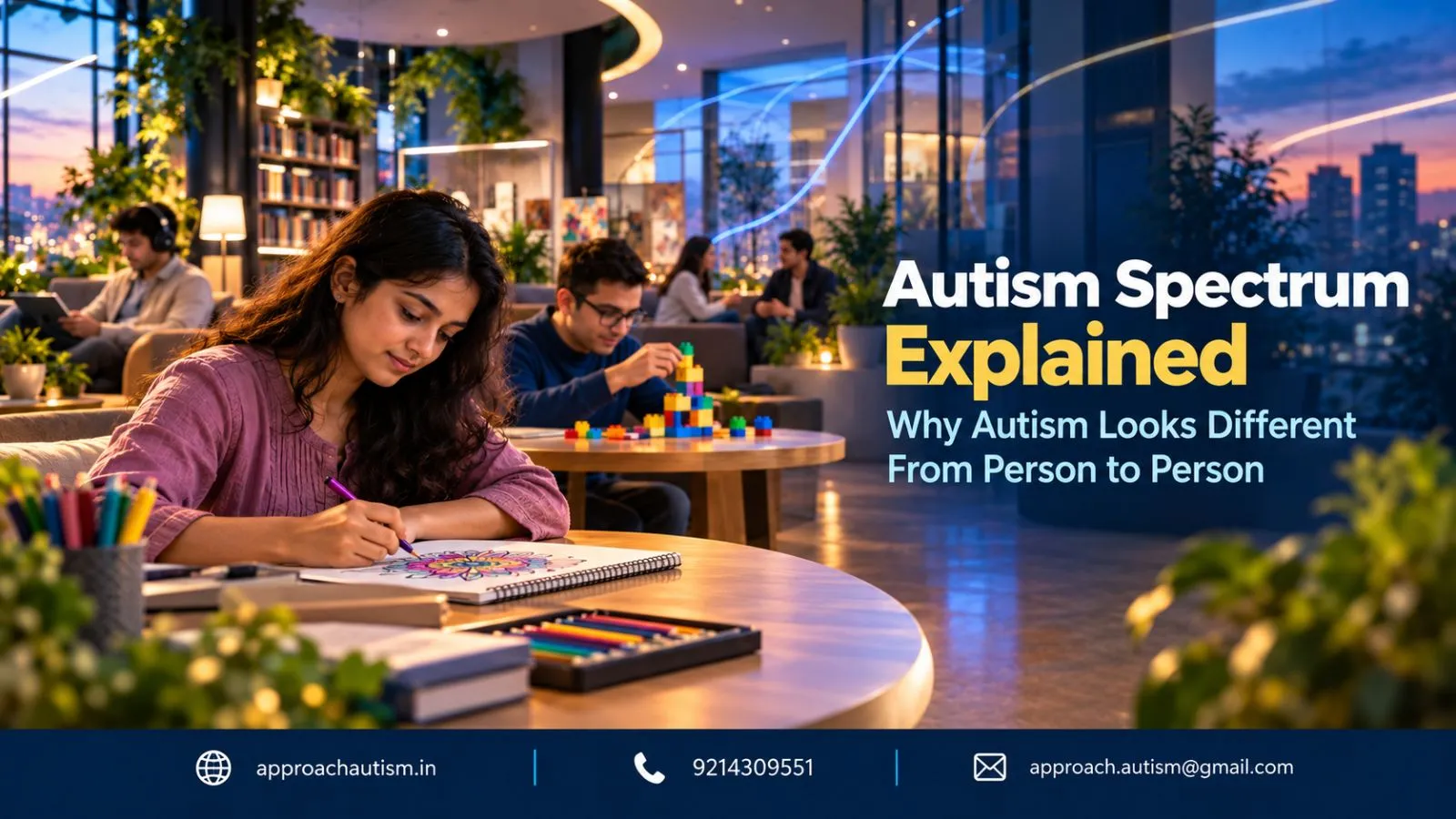
Autism Spectrum Explained: Why Autism Looks Different From Person to Person
-
by
Approach
- No Comments on Autism Spectrum Explained: Why Autism Looks Different From Person to Person
The autism spectrum explains why autism can look different from person to person. One autistic child may communicate using very few words, while another may speak fluently but find social conversations difficult. One person may need substantial daily support, while another may live independently but require help with employment, sensory regulation, or planning.
This variation is why autism is described as a spectrum. Autism is not a single set of behaviours, and it is not simply a straight line from “mild” to “severe.” Current diagnostic guidance considers differences in social communication and interaction alongside restricted or repetitive behaviours, while also recognising that support needs can vary.
Understanding the autism spectrum means looking at the whole person: communication, sensory experiences, learning, daily living, strengths, challenges, and the support needed in different environments.
What Does the Autism Spectrum Mean?
The autism spectrum refers to the wide range of ways autism can affect an individual’s development and everyday life.
Autism is a neurodevelopmental condition associated with differences in social communication and interaction, together with restricted or repetitive patterns of behaviour, interests, or activities.
However, these characteristics can appear in very different ways.
For example, two autistic people may both experience difficulty with social communication, but one may struggle to start conversations while another may speak extensively about a favourite subject but have difficulty recognising when another person wants to change the topic.
The spectrum therefore describes variation, not a ranking of autistic people.
Why Is Autism Called a Spectrum?
Autism is called a spectrum because there is considerable variation in characteristics, abilities, communication styles, and support needs.
A person can have significant sensory differences but relatively strong communication skills. Another person may have limited spoken communication but strong visual learning abilities.
Autism can also look different at different ages and in different environments.
A child who needs considerable support at school may develop greater independence as an adult. Similarly, an adult who appears highly independent may still experience substantial challenges that are less visible to others.
This is one reason autism should be understood as an individual profile rather than a fixed label.
Does Everyone With Autism Have the Same Characteristics?
No.
Autistic people do not all have the same characteristics, strengths, or support requirements.
Some commonly associated characteristics include:
- Differences in social communication
- Differences in non-verbal communication
- Repetitive movements or behaviours
- Strong preferences for routines
- Highly focused interests
- Sensory sensitivity or reduced sensitivity
- Differences in language development
- Difficulty with changes or transitions
A person does not need to display every possible characteristic.
Autism is identified using specific diagnostic criteria, but the way those characteristics appear can differ substantially between individuals.
The Different Ways Autism Can Present
Differences in Social Communication
Some autistic people may find it difficult to understand social cues, facial expressions, gestures, or the back-and-forth nature of conversation.
Others may communicate fluently but have difficulty with social context.
For example, an autistic adult may understand the words in a conversation but find sarcasm, indirect requests, or rapidly changing social expectations difficult to interpret.
Differences in Sensory Experiences
Sensory experiences can also vary.
Some autistic people may be highly sensitive to sounds, lights, textures, smells, or physical sensations. Others may seek certain sensory experiences or respond less strongly to particular sensory input.
Sensory differences can affect concentration, sleep, eating, travel, education, work, and participation in busy environments.
Differences in Repetitive Behaviors and Routines
Repetitive movements, speech, object use, or routines can be part of autism.
Some people may repeat movements to regulate themselves. Others may strongly prefer predictable routines or experience distress when plans change unexpectedly.
These behaviours should be understood in context. A repetitive behaviour may serve a communication, sensory, emotional, or self-regulation function.
Differences in Focus and Interests
Some autistic people develop highly focused interests.
These interests can become an important source of learning, enjoyment, motivation, or expertise.
The intensity and form of these interests can vary. A child may repeatedly explore one type of toy, while an adult may develop extensive knowledge about a specialised professional or personal interest.
Differences in Language and Communication
Language profiles can range widely.
Some autistic people may be non-speaking or use limited spoken language. Others may use complex vocabulary and speak at length.
Importantly, fluent speech does not necessarily mean that social communication is easy, and limited speech does not mean that a person has limited thoughts, preferences, or understanding.
Why Autism Can Look Different in Different People
Age and Development
Autism can change in how it is expressed as a person develops.
The demands placed on a child, teenager, adult, and older adult are different. A difficulty that is manageable in childhood may become more noticeable when social, academic, employment, or independent-living demands increase.
Research published in 2026 also highlights that autism across adulthood and later life is not a simple or uniform trajectory. Current evidence suggests considerable variation, with some characteristics changing over time while others persist.
Individual Strengths and Challenges
Every autistic person has an individual combination of strengths and challenges.
Strengths may include:
- Strong attention to detail
- Deep knowledge of specific subjects
- Visual learning
- Memory for particular information
- Persistence
- Pattern recognition
- Strong interest-driven learning
These strengths do not cancel out disability or support needs. A person can be highly skilled in one area and still require substantial help in another.
Communication Abilities
Communication is one of the areas where autism can look particularly different.
Some people use speech throughout the day. Others use gestures, pictures, communication devices, or a combination of methods.
Communication ability can also vary according to environment. A person may communicate differently at home, at school, in therapy, or in a busy public setting.
Support Needs
Support needs are individual and can change over time.
The DSM-5 framework describes three support levels for autism, from requiring support to requiring very substantial support. These levels are based on social communication and restricted/repetitive behaviours, rather than being a single score for the entire person.
This distinction is important because someone may require substantial support in one area but have greater independence in another.
Autism Spectrum in Children
Autism may become noticeable during early childhood through differences in communication, social interaction, play, sensory responses, or repetitive behaviours.
However, children can develop at different rates.
Some children may show clear developmental differences early, while characteristics may become more noticeable when social and learning demands increase.
Support can focus on communication, play, learning, sensory regulation, social participation, self-care, and functional skills.
The goal is not to make every child behave in exactly the same way. It is to help the child communicate, participate, learn, and develop useful skills.
Autism Spectrum in Teenagers
The teenage years can bring new social and academic demands.
Friendships, changing routines, academic expectations, emotional regulation, body changes, and increasing independence can all affect an autistic teenager.
A teenager who previously managed well may begin needing additional support when expectations become more complex.
Support may therefore need to expand beyond early developmental skills and include:
- Emotional regulation
- Social problem-solving
- Self-advocacy
- Study skills
- Travel and safety
- Personal care
- Vocational preparation
- Understanding social boundaries
Autism Spectrum in Adults
Autism continues throughout adulthood, although its presentation can change.
An adult may develop strategies for managing social situations or sensory challenges. These strategies can sometimes make autism less obvious to other people, even when the underlying difficulties remain.
Adult support may focus on employment, relationships, independent living, communication, community participation, and wellbeing.
Research in 2026 is increasingly examining autism across later adulthood, an area that has historically received less attention. Recent reviews highlight substantial variation in ageing experiences and the need for more autism-informed support for older adults.
Can Autism Characteristics Change Over Time?
Yes.
Autism is lifelong, but the way characteristics appear and the amount of support a person needs can change.
Development, learning, environment, coping strategies, health, social expectations, and life circumstances can all influence how autism presents.
For example, a child may initially need extensive help with communication and later develop an effective communication system. An adult may become more independent with daily tasks but continue to need support with employment or social situations.
This does not mean that a person has “outgrown” autism. It means their skills, environment, and support needs have changed.
Why Autism Should Not Be Described as a Simple Scale
A simple scale suggests that every autistic person can be placed somewhere between “mild” and “severe.”
Real-life autism is more complicated.
Consider two people:
Person A:
Has fluent speech and strong academic skills but experiences severe sensory difficulties, anxiety around unpredictable environments, and difficulty managing daily routines.
Person B:
Uses limited speech and needs substantial assistance with personal care but has strong visual skills and communicates effectively using an alternative communication system.
Which person is “more autistic”?
The question does not capture the complexity of autism.
A better approach is to ask: What are this person’s strengths, what challenges them, and what support helps them participate more independently?
Understanding Different Support Needs in Autism
Lower Support Needs
A person requiring less support may communicate verbally and manage many daily activities independently.
However, they may still need assistance with social communication, executive functioning, sensory regulation, employment, or navigating unfamiliar situations.
“Lower support needs” does not mean “no support needs.”
Moderate Support Needs
A person requiring substantial support may have more noticeable difficulties with communication, flexibility, social interaction, or repetitive behaviours.
They may need structured routines, communication support, assistance with daily tasks, or ongoing guidance across settings.
Higher Support Needs
A person requiring very substantial support may have significant communication, adaptive, behavioural, or sensory support needs.
Support may be needed across multiple areas of daily life, including personal care, safety, communication, learning, and community participation.
Support levels should not be treated as permanent predictions of what a person can or cannot achieve.
Common Misconceptions About the Autism Spectrum
Myth: Everyone With Autism Is Either Mild or Severe
Fact: Autism is not a simple two-category condition. Support needs can differ across domains and environments.
Myth: Autism Always Involves Intellectual Disability
Fact: Autism can occur across a wide range of intellectual abilities. Intellectual disability is not required for an autism diagnosis.
Myth: A Person Can Outgrow Autism
Fact: Autism is lifelong, although characteristics, coping strategies, skills, and support requirements can change over time.
Myth: Autism Looks the Same at Every Age
Fact: Autism can look different during childhood, adolescence, adulthood, and later life. Current research particularly highlights the need for more understanding of autism in older adults.
Key Takeaways
The autism spectrum is best understood as a range of individual developmental profiles, not a simple line from mild to severe.
The key points are:
- Autism can look very different from one person to another.
- Social communication and restricted or repetitive behaviours are central to autism diagnosis.
- Sensory experiences, language, interests, learning, and adaptive skills can vary significantly.
- Autism can present differently in children, teenagers, adults, and older adults.
- Support needs can change throughout life.
- Strong abilities in one area do not eliminate disability or support needs in another.
- Autism does not automatically mean intellectual disability.
- Current diagnostic levels describe support needs rather than ranking a person’s overall worth or ability.
- Emerging AI, wearable, VR, and digital technologies are being studied as tools for personalised autism support, but 2026 reviews still describe the evidence as preliminary and call for stronger, more inclusive research.
- The most useful way to understand an autistic person is to look at their individual strengths, challenges, environment, goals, and support needs.
Ultimately, understanding the autism spectrum means moving away from one-size-fits-all assumptions. The same diagnosis can affect two people in very different ways. Individualised assessment and support can help identify what each person needs to communicate, learn, participate, and build greater independence.
Frequently Asked Questions About the Autism Spectrum
Why is autism described as a spectrum?
Autism is described as a spectrum because autistic people can have very different combinations of communication differences, repetitive behaviours, sensory experiences, strengths, challenges, and support needs.
Are there different types of autism?
Current diagnostic practice generally uses one diagnosis: autism spectrum disorder (ASD). Older labels such as Asperger syndrome and pervasive developmental disorder were incorporated into the broader autism spectrum diagnosis in DSM-5.
Can two autistic people have very different characteristics?
Yes. Two autistic people can have very different communication abilities, sensory profiles, learning patterns, interests, daily-living skills, and support requirements.
Can autism characteristics change with age?
Yes. Autism remains lifelong, but characteristics can become more or less noticeable as a person’s skills, environment, coping strategies, and life demands change. Research on ageing suggests that these trajectories can be complex and highly individual.
What determines a person’s support needs?
Support needs depend on many factors, including communication abilities, adaptive skills, sensory differences, learning profile, behaviour, health, environment, and the demands of everyday life.