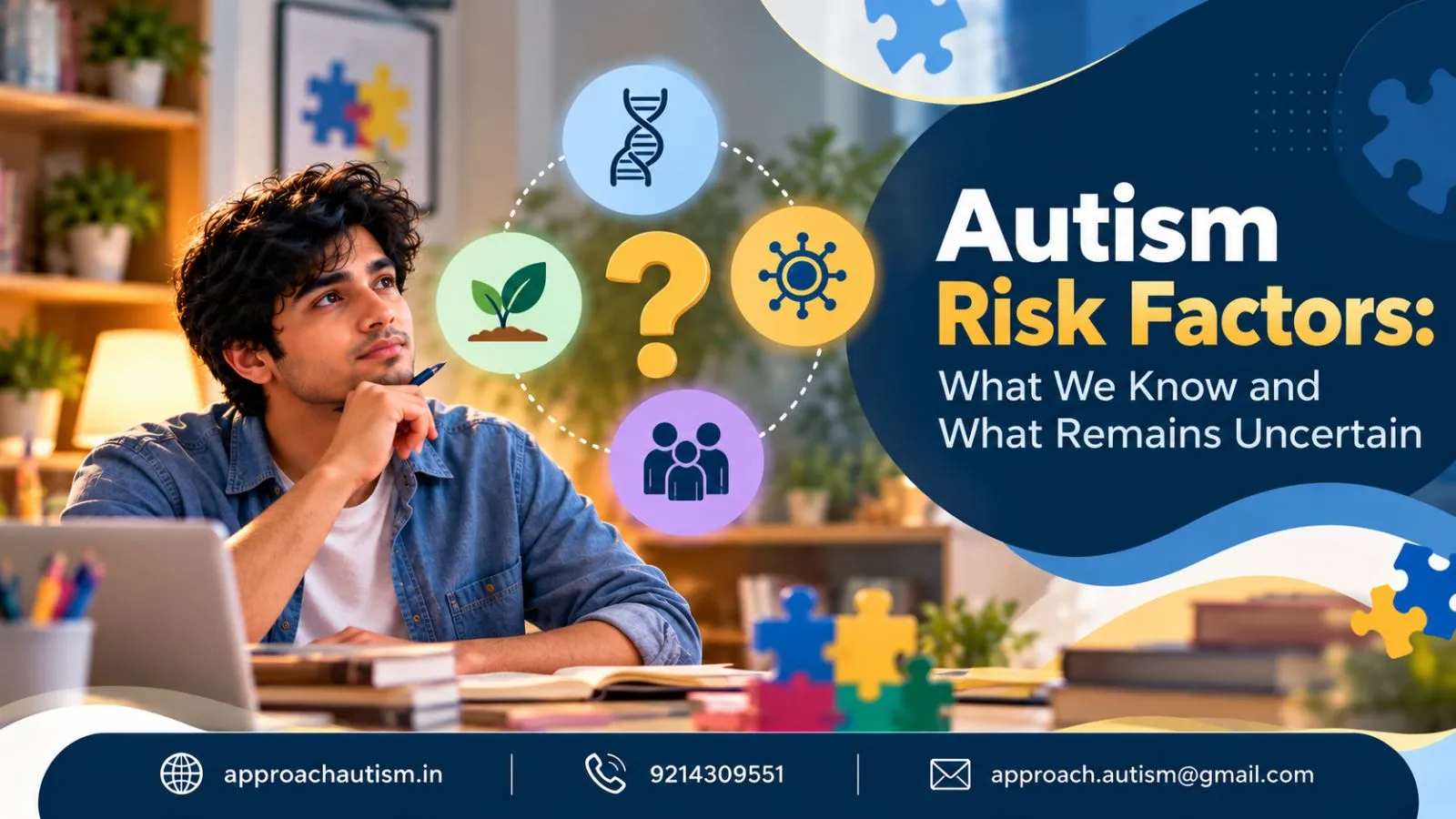
Autism Risk Factors: What We Know and What Remains Uncertain
 Approach
Understanding autism risk factors can help parents make informed decisions about child development without unnecessary fear or guilt. Research suggests that autism spectrum disorder (ASD) is associated with a combination of genetic, biological, and developmental factors. However, no single risk factor explains every case of autism, and having a risk factor does not mean a child will necessarily be autistic.
Autism is a neurodevelopmental condition that influences communication, social interaction, sensory experiences, and behaviour in different ways. Every autistic person has an individual profile of strengths, preferences, and support needs.
Researchers continue to study how autism develops. Understanding the current evidence helps families separate established findings from uncertain claims and focus on appropriate developmental support.
What Are Autism Risk Factors?
Understanding Risk Factors and Autism Causes
A risk factor is something associated with a greater likelihood of a particular condition. It does not automatically establish the cause of that condition in an individual.
For example, research has found associations between autism and certain genetic conditions, family history, and some pregnancy or birth-related factors. However, many people with these characteristics are not autistic. Autism can also occur in children without any recognised risk factors.
This distinction is important because autism develops through complex biological processes. Researchers have identified several contributing influences, but they have not established one universal explanation for every autistic person.
The term autism causes is therefore broader than a simple list of risk factors. A factor may contribute to developmental likelihood without being sufficient to explain why a particular child is autistic.
What Research Currently Tells Us
Evidence suggests that genetic influences play a substantial role in autism. Researchers have also identified associations with certain prenatal conditions, premature birth, very low birth weight, and some complications around birth.
These findings do not mean that every association is causal. Researchers must consider other factors that may influence study results, including family characteristics, health conditions, and differences in how studies are conducted.
The World Health Organization and the National Institute of Mental Health continue to describe autism as a complex condition involving multiple influences. More research is needed to understand how these factors interact and why their effects differ between individuals.
For families, the key message is simple: a risk factor cannot predict a child’s development with certainty.
Genetic Risk Factors for Autism
Family History and Autism Risk
Autism can occur in multiple members of the same family. This pattern supports the important role of genetics in autism development. Children who have an autistic sibling have a higher likelihood of being autistic than children without that family history.
However, the likelihood varies between families. Having an autistic relative does not mean another child will necessarily be autistic, and the absence of an autism diagnosis in the family does not rule it out.
Family history may also be incomplete. Some relatives might have had similar developmental characteristics without receiving a formal assessment.
If parents have questions about autism and family history, a developmental professional can discuss concerns and explain whether further assessment is appropriate. Family history alone cannot confirm or exclude an autism diagnosis.
Genetic Variations and Autism
There is no single gene responsible for all autism. Research has identified many genetic variations that can influence developmental likelihood. Some are common variations that may have small individual effects, while others are rare changes with a stronger association.
Certain genetic changes are inherited from a biological parent. Others occur spontaneously during the formation of reproductive cells or early development. These changes may be present even when there is no known family history of autism.
Genetic research also helps explain why autistic people can have different characteristics and support needs. Genetic influences are complex, and a genetic finding does not necessarily predict a person’s communication abilities, learning profile, or future independence.
Genetic Conditions Associated With Autism
Some genetic or chromosomal conditions are associated with a greater likelihood of autism. Examples include fragile X syndrome and tuberous sclerosis complex. These conditions can also involve other developmental, physical, or medical characteristics.
Not every autistic person has an identifiable genetic condition. In some cases, genetic testing may provide useful information, particularly when autism occurs alongside other developmental or medical concerns. However, testing cannot identify a genetic explanation for every case or replace a clinical autism assessment.
Families considering genetic testing should discuss its potential benefits and limitations with a qualified healthcare professional or genetic counsellor.
Pregnancy, Development, and What Does Not Cause Autism
Pregnancy and Birth-Related Factors
Research has identified associations between autism and certain prenatal or birth-related factors. These include older parental age, some maternal health conditions during pregnancy, premature birth, very low birth weight, and certain serious birth complications.
Researchers are investigating how these factors may relate to early brain development. However, an association does not establish that a factor directly caused autism. Many pregnancies involving these circumstances do not result in an autistic child, and autism also occurs after pregnancies without recognised complications.
Parents should continue routine prenatal care and follow medical advice for their individual circumstances. Medication should not be stopped or changed during pregnancy without consulting the prescribing healthcare professional.
Early Brain Development and Environmental Research
Autism is associated with differences in early brain development. Researchers are studying how genetic influences and biological processes affect the development of communication, sensory processing, learning, and social interaction.
Some environmental exposures and pregnancy-related conditions are also under investigation. Scientists must distinguish between a statistical association and a demonstrated cause before drawing conclusions.
Research in this area continues to develop. Findings may improve understanding of autism, but they should not be used to assign blame to parents or to make confident predictions about an individual child.
What Does Not Cause Autism?
Several persistent myths can create unnecessary anxiety for families. Scientific evidence does not support the claim that vaccines cause autism. The World Health Organization’s 2025 review of evidence published between 2010 and August 2025 reaffirmed that available high-quality research does not support a causal relationship between vaccines and autism.
Autism is also not caused by bad parenting. Parenting style, a lack of affection, or a child’s everyday experiences do not explain autism. Likewise, there is no established evidence that ordinary foods or a particular diet cause autism.
Some autistic people may have dietary preferences, food sensitivities, or co-occurring medical conditions that affect nutrition. These concerns deserve individual attention, but they should not be confused with the cause of autism.
Families should be cautious about treatments or diets promoted as ways to prevent or cure autism. Any major dietary change or medical intervention should be discussed with a qualified professional.
Can Autism Be Prevented or Predicted?
There is currently no established method that can guarantee the prevention of autism. Because autism involves complex developmental and genetic influences, it is not possible to eliminate every factor associated with its likelihood.
Similarly, risk factors cannot reliably predict whether a particular child will be autistic. Prenatal history, family history, and genetic findings may provide useful context, but none can determine every child’s developmental outcome.
Instead of focusing on prevention, families can prioritise appropriate prenatal care, routine developmental monitoring, and timely assessment when concerns arise.
Parents who notice differences in communication, social interaction, play, or development should discuss them with a qualified healthcare professional. An assessment can help identify a child’s needs and guide suitable support.
Access to individualised developmental services can make a meaningful difference in everyday life. Families looking for guidance can explore the resources offered by an autism support centre in Jaipur.
Conclusion
Autism risk factors include genetic influences, family history, certain genetic conditions, and some pregnancy or birth-related factors. However, these associations do not provide a complete explanation for every case of autism.
The evidence also makes important distinctions clear: vaccines and parenting do not cause autism, and no single risk factor can reliably predict a child’s developmental future.
Research continues to improve our understanding of autism and early brain development. Until more is known, families should avoid unproven claims, seek professional guidance when developmental concerns arise, and focus on respectful, individualised support.
Understanding risk factors is useful, but supporting each autistic person’s communication, well-being, preferences, and development is just as important.