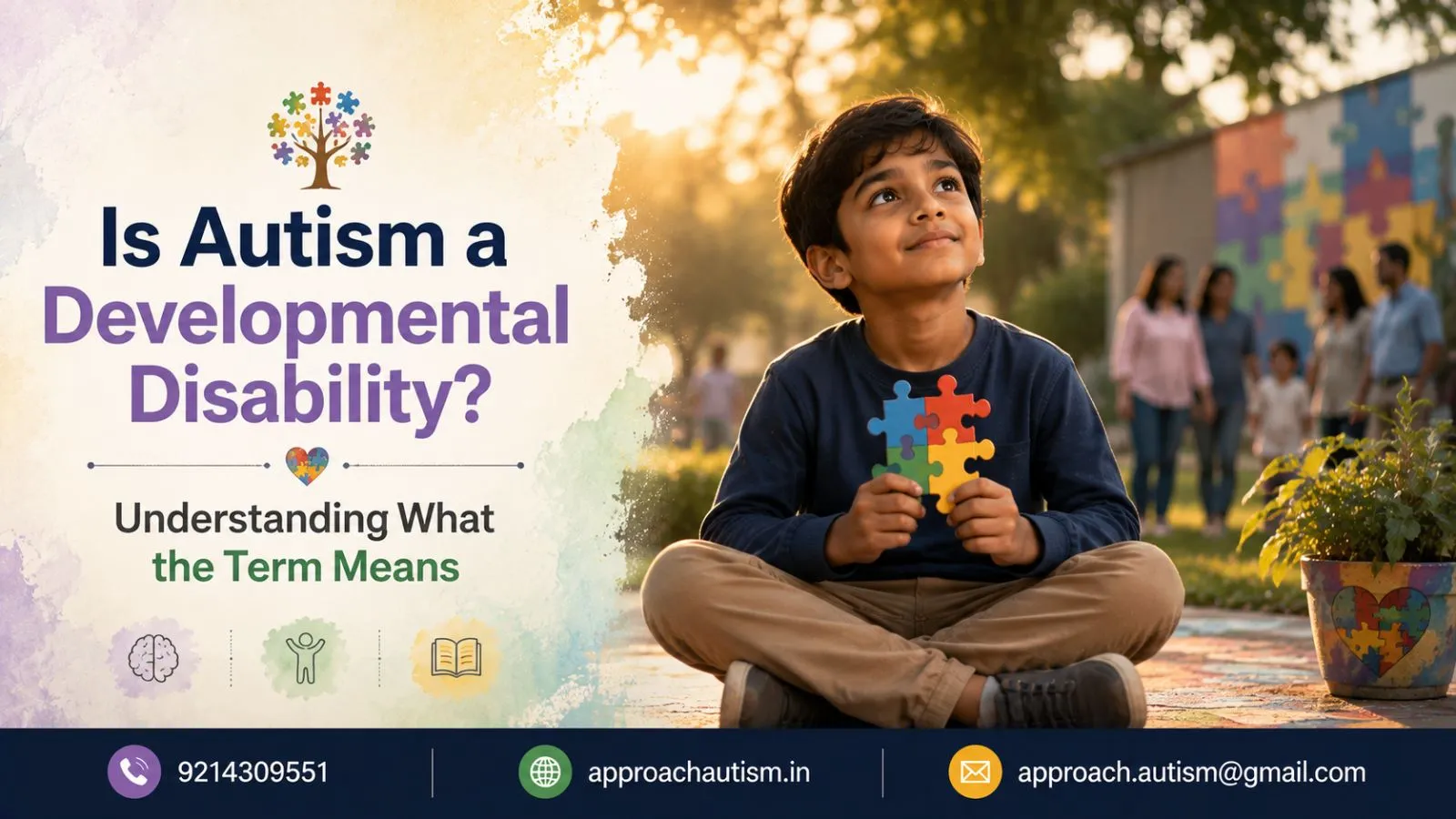
Is Autism a Developmental Disability? Understanding What the Term Means
 Approach
A developmental disability is a condition that begins during the developmental period and can affect areas such as learning, communication, behavior, physical functioning, independent living or everyday participation.
Developmental disabilities can vary significantly in their characteristics and support requirements. Some people may require occasional assistance, while others may need substantial lifelong support.
The term describes the impact a developmental condition can have on a person’s functioning and participation. It does not mean that every person with the same diagnosis will have identical abilities or support needs.
Developmental disability should therefore be understood in an individual context.
Is Autism Considered a Developmental Disability?
Yes, autism can be considered a developmental disability, depending on the definition and legal or service framework being used. Autism is also widely described medically as a neurodevelopmental condition.
The National Institute of Mental Health describes autism spectrum disorder as a neurological and developmental disorder that affects how people interact, communicate, learn and behave. Autism is described as developmental because its characteristics generally emerge during early development.
However, it is important to separate the medical description of autism from the question of whether an individual qualifies as disabled under a particular law, benefits program or support system.
A person’s disability status may depend on how their characteristics affect everyday functioning and on the criteria used by the relevant authority.
Why Is Autism Described as a Neurodevelopmental Condition?
The term neurodevelopmental condition refers to conditions associated with the development and functioning of the nervous system.
Autism begins during the developmental period, although it may be identified at different ages. Some people are diagnosed during childhood, while others may not receive an autism diagnosis until adolescence or adulthood.
Autism can involve differences in:
- Social communication
- Social interaction
- Sensory processing
- Repetitive behaviors
- Restricted or highly focused interests
- Adaptation to changes and transitions
Not every autistic person experiences the same characteristics or requires the same level of support.
This variation is one reason autism is described as a spectrum.
Autism and Developmental Disability: What Is the Difference?
The terms are related, but they are not interchangeable.
Neurodevelopmental Conditions Explained
A neurodevelopmental condition relates to differences in development and functioning of the nervous system.
Autism is one example. Other neurodevelopmental conditions include ADHD and certain intellectual or communication-related developmental conditions.
These conditions can affect people differently and may sometimes occur together.
Developmental Disabilities Explained
Developmental disability is a broader concept that focuses on significant developmental limitations and their impact on everyday functioning and participation.
Depending on the framework being used, it may include conditions affecting intellectual, physical, communication, behavioral or adaptive functioning.
The exact definition can differ between countries, laws and service systems.
Where Autism Fits Into These Definitions
Autism fits within the broader category of neurodevelopmental conditions and can also meet definitions of developmental disability when its characteristics result in significant functional limitations.
Therefore, the most accurate answer to “is autism a developmental disability?” is not simply yes or no in every context.
Medically, autism is a neurodevelopmental condition. In disability and support contexts, autism may be recognized as a developmental disability when it meets the applicable criteria.
How Autism Can Affect Development
Autism can affect different areas of development and everyday functioning.
Communication and Language
Some autistic people experience differences in spoken language, conversational communication or understanding social aspects of communication.
Others may have strong spoken-language abilities but experience difficulty with implied meaning, sarcasm, tone or conversational expectations.
Some people use alternative or augmentative communication.
Communication ability can therefore vary considerably across the autism spectrum.
Social Development
Autistic people may experience differences in understanding or navigating social interactions.
This can include difficulty interpreting:
- Facial expressions
- Body language
- Social cues
- Unspoken expectations
- Back-and-forth conversation
These differences do not mean that autistic people lack interest in relationships.
Many autistic adults develop meaningful friendships, partnerships and social connections, although they may prefer different communication styles or environments.
Learning and Problem-Solving
Autism does not automatically indicate an intellectual disability.
Autistic people have a wide range of intellectual abilities. Some may have significant learning challenges, while others may have average or above-average intellectual abilities.
NIMH notes that autistic people can have a wide range of characteristics, needs, strengths and challenges.
Learning profiles may also be uneven. An individual can have significant strengths in one area while needing support in another.
Adaptive and Everyday Functioning
Adaptive functioning refers broadly to how a person manages everyday activities and responsibilities.
Some autistic adults may need support with:
- Managing schedules
- Using public transportation
- Workplace routines
- Household responsibilities
- Communication
- Healthcare appointments
- Managing sensory environments
Other autistic adults may live independently and manage these activities without significant assistance.
Support needs should therefore be assessed individually.
Is Every Autistic Person Considered Disabled?
Not necessarily in every legal, social or functional context.
Autism can be disabling for some people because characteristics may substantially affect communication, employment, independent living, education or other areas of life.
For others, support needs may be limited or may be required only in particular environments.
This distinction is important because diagnosis and disability status are not always identical concepts.
A person can be autistic and have significant support needs. Another autistic person may live independently, work, manage their household and participate fully in community life while still experiencing meaningful challenges.
The existence and level of disability should not be assumed solely from the diagnosis.
Autism and Disability: Why Individual Differences Matter
Different Strengths and Challenges
Autistic people have different combinations of strengths and challenges.
Some may have strong memory, detailed knowledge, visual learning abilities or specialized interests. Others may experience substantial challenges with communication, sensory regulation or everyday activities.
NIMH specifically notes that autistic people have a broad range of strengths, needs and challenges.
Different Levels of Support Needs
Support requirements can range from relatively limited assistance to substantial daily support.
One person may need workplace adjustments, while another may need ongoing help with personal care, communication or decision-making.
Support needs can also change throughout life.
For example, a person may function relatively independently in a familiar environment but require additional support during major transitions.
How Disability Can Affect Daily Life
When autism is disabling for an individual, its impact may be seen in areas such as:
- Employment
- Communication
- Independent living
- Education
- Relationships
- Community participation
- Sensory environments
Understanding these practical effects is more useful than making assumptions based solely on an autism diagnosis.
Autism as a Developmental Disability in Children
Autism is a developmental condition, meaning its characteristics emerge during development. NIMH notes that autism can be diagnosed at any age, even though characteristics generally appear in the first two years of life.
In children, autism may affect communication, social interaction, play, sensory processing and adaptation to changes.
Some children may require substantial developmental and educational support, while others may need relatively limited accommodations.
Early identification can help families understand a child’s strengths and support needs.
However, a child’s diagnosis should not be used to predict exactly what they will be capable of achieving as an adult.
Autism as a Developmental Disability in Adults
Autism is lifelong, but the way it affects an individual can change across different stages of life.
An autistic adult may experience challenges with:
- Employment
- Social communication
- Sensory environments
- Independent living
- Managing unexpected changes
- Healthcare access
- Daily organization
Some adults may require ongoing support, while others may live independently with occasional accommodations.
Adult autism assessment can also be important for people who were not identified during childhood. NIMH notes that adult diagnosis can be more challenging because autism characteristics can overlap with other conditions, and developmental history may be important during evaluation.
Autism, Disability and Legal or Social Recognition
The way autism is classified for legal, benefits or disability-support purposes can vary by country and by the specific program involved.
A medical diagnosis of autism does not necessarily answer every legal question about eligibility for services.
For example, a person may need to demonstrate how a condition affects functioning to qualify for a particular support program.
In India, disability recognition and access to government benefits are governed by applicable disability laws, rules and certification procedures. The specific eligibility requirements should therefore be checked with the appropriate authority or qualified professional rather than assumed from a diagnosis alone.
For an NGO working with autistic adults, this distinction is especially important when explaining disability certificates, employment accommodations, social support or government schemes.
Common Misconceptions About Autism and Disability
Myth: Everyone With Autism Has the Same Disability
Fact: Autism is a spectrum. People can have very different communication abilities, strengths, challenges and support requirements.
Myth: Autism Always Causes Intellectual Disability
Fact: Autism does not automatically mean intellectual disability. Autistic people have a wide range of intellectual abilities.
Myth: A Person Cannot Be Disabled If They Have Strong Abilities
Fact: A person can have significant strengths and still experience disability in particular areas of everyday life.
For example, an autistic adult may have excellent professional knowledge but still require workplace accommodations because of sensory or communication differences.
Strengths and disability can exist at the same time.
Key Takeaways
So, is autism a developmental disability? The answer depends partly on the context. Autism is medically recognized as a neurodevelopmental condition and is also commonly recognized within developmental-disability frameworks when it results in significant functional limitations.
Autism does not affect every person in the same way. Some autistic people require substantial lifelong support, while others live independently and need only specific accommodations. Autism also does not automatically mean that a person has an intellectual disability.
For autistic adults and their families, it is important to focus on individual abilities, support needs, communication preferences and participation in everyday life rather than making assumptions from a diagnosis alone.
Understanding the difference between a neurodevelopmental condition and disability recognition can also help reduce stigma and improve access to appropriate support. A diagnosis is one part of understanding a person; it does not define their abilities, identity or potential.
Frequently Asked Questions
Is autism a developmental disability or a mental illness?
Autism is medically described as a neurodevelopmental condition, rather than simply being classified as a mental illness. NIMH describes autism as a neurological and developmental disorder. Whether autism is recognized as a developmental disability for legal or service purposes depends on the applicable definition and criteria.
Is autism considered a lifelong developmental disability?
Autism is generally considered lifelong, although its characteristics and support needs can change throughout a person’s life. Some autistic adults require substantial ongoing support, while others live independently with limited accommodations.
Can an autistic person live independently?
Yes. Some autistic people live independently, work, manage their homes and make their own decisions. Others require different levels of support. Autism is a spectrum, so independence and support needs vary significantly between individuals.
Does being autistic automatically mean someone is disabled?
Not necessarily in every legal or functional context. Autism can be disabling when its characteristics substantially affect a person’s everyday functioning. Legal recognition and eligibility for specific services depend on the relevant criteria.
What is the difference between autism and other developmental disabilities?
Autism is a specific neurodevelopmental condition primarily associated with differences in social communication and interaction and restricted or repetitive patterns. Other developmental disabilities can involve different primary areas, such as intellectual, physical, communication or adaptive functioning. Some conditions can also occur together with autism.