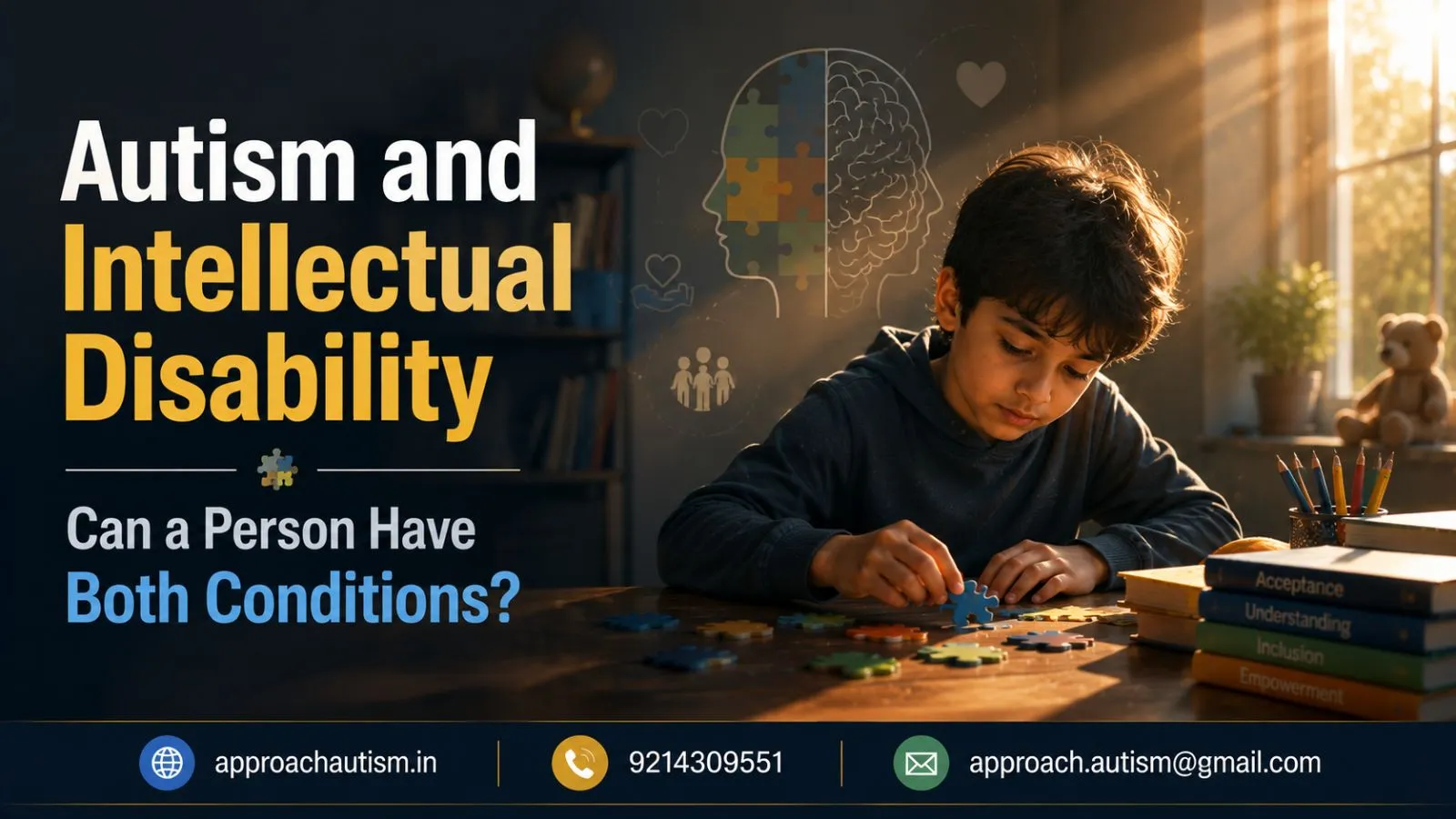
Autism and Intellectual Disability: Can a Person Have Both Conditions?
 Approach
Autism spectrum disorder (ASD), commonly called autism, is a neurodevelopmental condition associated with differences in social communication, social interaction, sensory processing and patterns of behavior or interests.
Autism is described as a spectrum because it can affect people in very different ways.
Some autistic people may communicate using spoken language, while others may use alternative or augmentative communication. Some may live independently, while others may require substantial support with communication, daily activities or decision-making.
Common characteristics can include:
- Differences in social communication
- Differences in social interaction
- Repetitive movements or behaviors
- Strong or focused interests
- Preference for predictability
- Sensory sensitivities or sensory-seeking behaviors
Autism does not automatically mean that a person has an intellectual disability.
An autistic person’s abilities can be uneven. Someone may have significant strengths in one area and require substantial support in another.
What Is Intellectual Disability?
Intellectual disability (ID) is a developmental condition involving significant limitations in both intellectual functioning and adaptive behavior, with onset during the developmental period.
Intellectual functioning includes abilities such as:
- Learning
- Reasoning
- Problem-solving
- Planning
- Understanding new information
- Applying knowledge to different situations
Adaptive functioning refers to how a person manages everyday life.
It commonly includes:
Conceptual skills: communication, reading, writing, money concepts and time management.
Social skills: communication, social judgment, understanding relationships and responding appropriately in social situations.
Practical skills: personal care, household activities, safety, transportation and managing everyday responsibilities.
Intellectual disability can range from mild to profound, and support needs can vary considerably between individuals.
Importantly, intellectual disability should not be understood simply as having a “low IQ.” A comprehensive assessment considers both intellectual functioning and adaptive functioning.
Can Autism and Intellectual Disability Occur Together?
Yes. Autism and intellectual disability can occur together.
Some autistic people have an intellectual disability, while many do not.
When both conditions are present, a person’s support needs may be influenced by characteristics associated with autism as well as limitations in intellectual and adaptive functioning.
For example, an autistic adult with intellectual disability may need additional support with communication, daily living, transportation, decision-making or employment.
However, the combination does not define the person’s entire identity or abilities.
Every individual has their own strengths, preferences, communication style and support needs.
Autism vs Intellectual Disability: Understanding the Difference
Autism and intellectual disability are different conditions, even though they can co-occur.
Differences in Definition
Autism is primarily associated with differences in social communication and interaction, along with restricted or repetitive patterns of behavior, interests or activities.
Intellectual disability involves significant limitations in intellectual functioning and adaptive functioning that begin during the developmental period.
Therefore, the defining characteristics are different.
Differences in Cognitive Abilities
Autistic people can have a wide range of intellectual abilities.
Some have intellectual disabilities, while others have average or above-average intellectual abilities.
Intellectual disability specifically involves significant limitations in intellectual functioning.
This means that autism alone cannot be used to predict a person’s intellectual ability.
Differences in Social Communication
Social communication differences are an important part of autism.
A person with intellectual disability may also experience communication difficulties, particularly when intellectual and language development are affected.
However, communication challenges in an autistic person and a person with intellectual disability can have different underlying causes.
A person can also have both conditions, making individual assessment especially important.
Differences in Adaptive Functioning
Adaptive functioning describes how effectively a person manages everyday life.
An autistic person without intellectual disability may have strong intellectual abilities but still need support with certain adaptive skills because of executive functioning, sensory needs or social communication differences.
Similarly, a person with intellectual disability may need support with conceptual, social or practical skills.
When both conditions occur together, support planning should consider both sets of needs.
How Intellectual Disability May Present Alongside Autism
When autism and intellectual disability occur together, their characteristics may interact in different ways.
Learning and Problem-Solving Differences
A person may need more time, repetition or practical demonstrations when learning a new skill.
Abstract concepts may be particularly difficult for some individuals.
Teaching approaches can be adapted using:
- Simple instructions
- Visual supports
- Step-by-step demonstrations
- Repetition
- Practical examples
- Consistent routines
Support should be based on the person’s actual abilities rather than assumptions about what they can or cannot learn.
Communication and Language Differences
Communication abilities can vary significantly.
Some people may use spoken language, while others may communicate through gestures, communication boards, speech-generating devices or other methods.
Autism can affect the social use of communication, while intellectual disability can affect language development and understanding.
When both occur together, individualized communication support can be particularly valuable.
Daily Living and Adaptive Skills
Some individuals may require support with:
- Personal hygiene
- Cooking
- Money management
- Travel
- Household tasks
- Medication routines
- Safety awareness
- Healthcare appointments
Support should encourage independence wherever possible rather than unnecessarily taking control away from the individual.
Social and Behavioral Characteristics
Autistic characteristics such as repetitive behaviors, sensory differences or strong preferences for routine may occur alongside intellectual disability.
A person may also have difficulty communicating discomfort, pain, frustration or emotional needs.
What appears to be “challenging behavior” may sometimes be a form of communication.
Understanding the environment and identifying possible triggers can therefore be more helpful than simply trying to stop the behavior.
Can Someone Have Autism Without Intellectual Disability?
Yes.
Many autistic people do not have an intellectual disability.
An autistic person may have average or above-average intellectual abilities while still experiencing significant challenges involving sensory processing, social communication, routines or daily functioning.
Intellectual ability and support needs are not the same thing.
For example, an autistic adult may have strong academic or professional abilities but require workplace accommodations because of sensory sensitivity or communication differences.
This is why autism should never be equated with intellectual disability.
Can Someone Have Intellectual Disability Without Autism?
Yes.
A person can have an intellectual disability without being autistic.
Intellectual disability and autism are separate developmental conditions.
Some people with intellectual disability may experience communication or social difficulties, but these do not automatically indicate autism.
Autism requires a specific pattern of characteristics involving social communication and restricted or repetitive behaviors or interests.
A professional assessment considers the complete developmental picture before determining whether autism is also present.
How Autism and Intellectual Disability Are Identified
Autism and intellectual disability are identified through different assessment processes, although both may be evaluated during a broader developmental assessment.
Developmental History
Professionals may review early developmental milestones, communication, social interaction, learning and behavior.
Information from parents, caregivers or other people who know the individual’s developmental history may be useful.
For adults, childhood records and historical information can sometimes help when evaluating lifelong characteristics.
Cognitive Assessment
Cognitive assessments may evaluate areas such as:
- Reasoning
- Memory
- Problem-solving
- Processing
- Learning abilities
The specific assessment depends on the person’s age, communication abilities and circumstances.
Test results should not be interpreted in isolation.
Adaptive Functioning Assessment
Adaptive functioning evaluates how a person manages everyday life.
Professionals may consider conceptual, social and practical skills.
For example, they may look at how the person manages communication, personal care, money, transportation, safety and household responsibilities.
Autism-Specific Evaluation
Autism evaluation focuses on characteristics such as:
- Social communication
- Social interaction
- Repetitive behaviors
- Restricted interests
- Sensory differences
- Developmental history
A comprehensive assessment can help distinguish autism from other developmental conditions and determine whether multiple conditions are present.
Autism and Intellectual Disability in Children
In children, autism and intellectual disability may sometimes be identified during developmental or educational evaluations.
A child may show differences in communication, learning, adaptive skills or social interaction.
Early identification can help families understand the child’s strengths and support needs.
However, developmental abilities change as children grow.
Assessment should therefore consider the child’s developmental stage rather than relying on a single observation.
Support can include educational accommodations, communication interventions, occupational support and other services based on individual needs.
Autism and Intellectual Disability in Adults
Autistic adults with intellectual disability may have different levels of independence and support needs.
Some may live with family, while others may live in supported housing or more independently with appropriate assistance.
Adult support may involve:
- Employment assistance
- Independent-living skills
- Communication support
- Healthcare access
- Transportation
- Financial decision-making
- Community participation
- Social opportunities
Support should remain person-centred throughout adulthood.
Being an adult with intellectual disability does not mean that the person cannot make choices or participate in decisions about their own life.
Whenever possible, communication should be adapted so the individual can understand options and express preferences.
Why Distinguishing the Two Conditions Matters
Understanding the difference between autism and intellectual disability can lead to more appropriate support.
If autism is incorrectly assumed to mean intellectual disability, a person’s abilities may be underestimated.
On the other hand, if intellectual disability is overlooked, someone may not receive the level of practical or learning support they need.
Accurate identification can help professionals and families understand:
- Communication needs
- Learning requirements
- Sensory preferences
- Adaptive skills
- Independence goals
- Educational needs
- Employment support
- Community participation
Most importantly, assessment should identify what support the individual needs, rather than focusing only on diagnostic labels.
Common Misconceptions About Autism and Intellectual Disability
One common misconception is that autism is an intellectual disability. It is not. Autism and intellectual disability are separate conditions, although they can occur together.
Another misconception is that autistic people cannot have average or above-average intelligence. This is also incorrect. Autistic people have a wide range of intellectual abilities.
It is also inaccurate to assume that a person with intellectual disability cannot communicate, learn new skills or make decisions.
People with intellectual disabilities can learn, develop skills and participate in decisions when information and communication are adapted appropriately.
Another important misconception is that a diagnosis tells you everything about a person.
It does not.
A diagnosis can help explain certain characteristics and support needs, but it cannot describe an individual’s personality, strengths, interests, preferences or potential.
Key Takeaways
Autism and intellectual disability are different conditions, although they can occur in the same person. Autism is a neurodevelopmental condition associated with differences in social communication, interaction, sensory processing and repetitive patterns or interests. Intellectual disability involves significant limitations in intellectual functioning and adaptive behavior that begin during development.
An autistic person may have average or above-average intellectual abilities, while another autistic person may also have an intellectual disability. Similarly, a person with intellectual disability may or may not be autistic.
Understanding this distinction is important because assumptions about intelligence can lead to inappropriate expectations or missed support opportunities. Comprehensive assessment considers developmental history, cognitive abilities, adaptive functioning, communication and autism-specific characteristics.
For autistic adults and their families, the most useful approach is to focus on individual strengths, communication preferences, independence and support needs rather than allowing a diagnostic label to define what a person can achieve.
Frequently Asked Questions
Is autism an intellectual disability?
No. Autism and intellectual disability are different conditions. Autism is a neurodevelopmental condition associated with differences in social communication, interaction and restricted or repetitive patterns. Intellectual disability involves significant limitations in intellectual and adaptive functioning.
Can an autistic person have an intellectual disability?
Yes. Autism and intellectual disability can occur together. Some autistic people have intellectual disabilities, while many autistic people do not. The level of intellectual and adaptive functioning varies considerably between individuals.
Can a person with intellectual disability also be autistic?
Yes. A person with intellectual disability can also meet the diagnostic criteria for autism. The two conditions are separate, so an assessment needs to consider the characteristics associated with each condition.
Does autism always affect intelligence?
No. Autism does not automatically mean that a person has an intellectual disability or reduced intelligence. Autistic people have a wide range of intellectual abilities, from significant intellectual disability to average and above-average abilities.
How are autism and intellectual disability different?
Autism primarily involves differences in social communication and interaction, along with restricted or repetitive patterns. Intellectual disability involves significant limitations in intellectual functioning and adaptive functioning that begin during the developmental period. They can occur independently or together.