Autism and Mental Health: Common Co-Occurring Conditions in Autistic People
-
by
Approach
- No Comments on Autism and Mental Health: Common Co-Occurring Conditions in Autistic People
Autism and mental health are closely connected topics, but they should not be treated as the same thing. Autism is a neurodevelopmental condition, while mental health conditions such as anxiety and depression are separate clinical conditions.
An autistic person can have good mental health, experience temporary emotional distress, or have one or more mental health conditions. The presence of autism does not automatically mean that someone has a mental illness.
However, research and clinical experience indicate that autistic people can experience mental health difficulties at higher rates than the general population. Understanding this connection can help families, caregivers and autistic adults recognize when additional support may be useful.
Mental well-being can be influenced by many factors, including:
- Sensory sensitivity
- Social expectations
- Communication barriers
- Workplace or educational pressures
- Changes in routine
- Social isolation
- Masking or camouflaging
- Lack of appropriate support
For autistic adults, recognizing these factors can be particularly important because some challenges may remain unnoticed for years.
What Does Co-Occurring Mean in Autism?
The term co-occurring means that two or more conditions or health-related difficulties exist in the same person.
For example, an autistic person may also have an anxiety disorder or depression. In that situation, autism and the mental health condition are considered separate conditions that occur together.
Co-occurring conditions can affect how a person experiences everyday life.
Importantly, not every autistic person has a co-occurring mental health condition. Each person’s experiences, support needs and circumstances are different.
When autism and another condition occur together, professionals may need to consider both when providing assessment and support.
Common Mental Health Conditions Associated With Autism
Autistic people can experience many of the same mental health conditions as other people. Some conditions and challenges may be particularly important to monitor because they can significantly affect daily functioning.
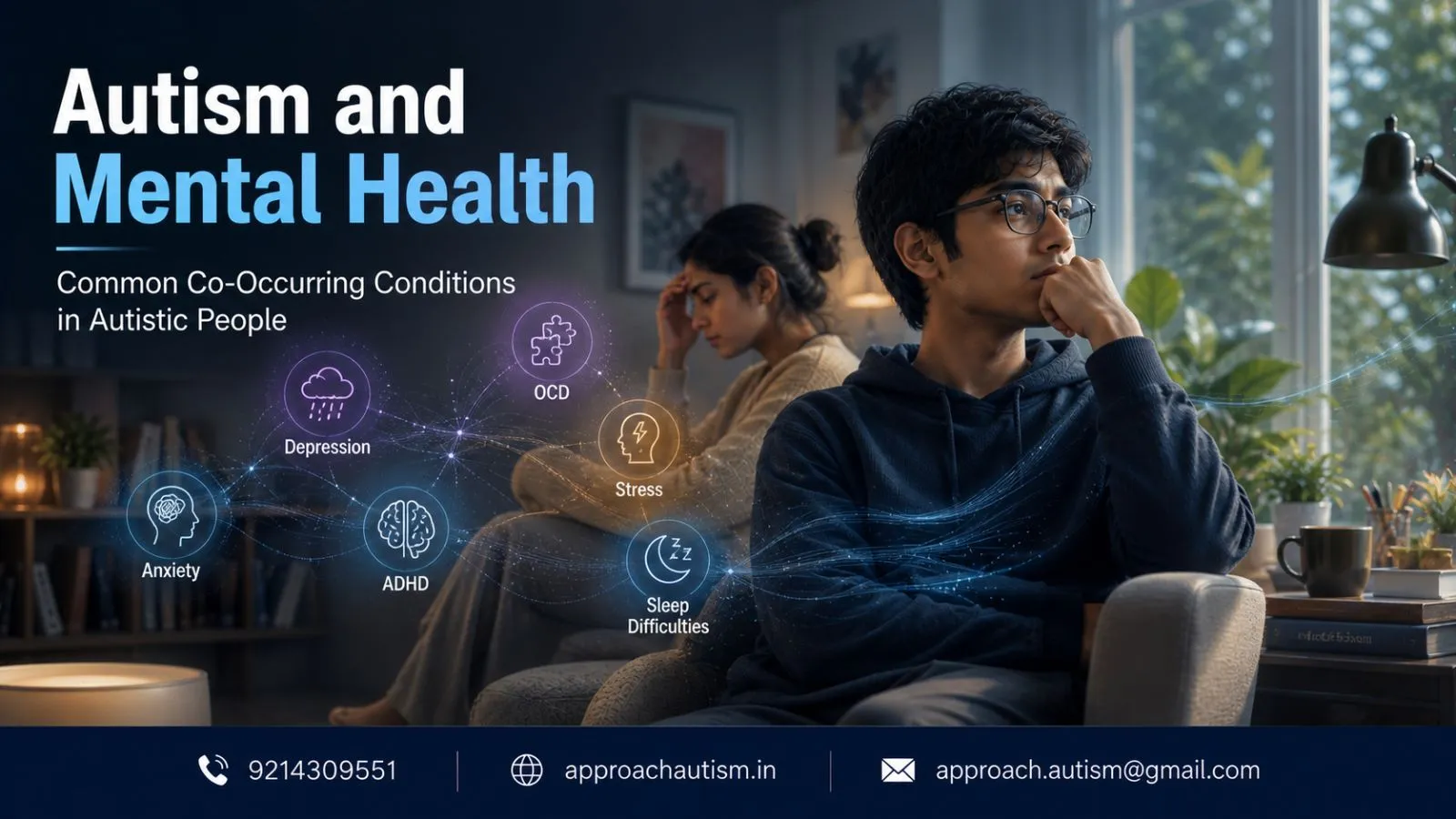
Anxiety Disorders
Anxiety is commonly reported among autistic people.
Anxiety can involve persistent worry, fear, nervousness or physical symptoms such as increased heart rate and difficulty relaxing.
For an autistic person, anxiety may sometimes be associated with:
- Unpredictable situations
- Social demands
- Sensory overload
- Changes in routine
- Communication difficulties
- Fear of unfamiliar environments
However, not every autistic preference for routine or avoidance of certain environments should be interpreted as an anxiety disorder.
A qualified professional can help determine whether anxiety is causing significant distress or impairment.
Depression
Depression is another important mental health condition that can occur alongside autism.
Possible signs include:
- Persistent sadness or low mood
- Loss of interest in previously enjoyable activities
- Changes in sleep
- Changes in appetite
- Low energy
- Difficulty concentrating
- Feelings of hopelessness
- Reduced participation in everyday activities
Depression can sometimes be difficult to identify in autistic people because changes may appear differently from person to person.
A noticeable change from an individual’s usual behavior, communication or daily functioning can be an important reason to seek professional assessment.
Obsessive-Compulsive Symptoms
Some autistic people may experience obsessive-compulsive symptoms or obsessive-compulsive disorder (OCD).
Autism can involve repetitive behaviors, routines and highly focused interests. OCD, in contrast, involves obsessions and/or compulsions that are typically associated with unwanted intrusive thoughts and repetitive actions performed in response to those thoughts or to reduce distress.
The two can sometimes look similar from the outside.
For example, a person may repeatedly perform an action, but the reason behind that behavior can be very different.
Professional assessment is useful when it is difficult to distinguish autistic repetitive behavior from OCD symptoms.
Attention-Deficit/Hyperactivity Disorder (ADHD)
ADHD is a neurodevelopmental condition rather than a mental illness, and it can co-occur with autism.
A person with both autism and ADHD may experience challenges involving:
- Attention
- Organization
- Impulse control
- Time management
- Executive functioning
- Sensory regulation
- Routine management
Recognizing both conditions can help professionals understand the individual’s needs more accurately.
Support strategies may need to address autistic characteristics and ADHD-related difficulties separately.
Sleep-Related Problems and Mental Well-Being
Sleep problems are commonly reported by autistic people.
Difficulty falling asleep, staying asleep, maintaining a consistent sleep schedule or getting restorative sleep can affect overall well-being.
Poor sleep can contribute to:
- Fatigue
- Irritability
- Difficulty concentrating
- Reduced emotional regulation
- Increased stress
Sleep difficulties can also occur alongside anxiety or depression.
Persistent sleep problems should be discussed with an appropriately qualified healthcare professional, particularly when they significantly affect daytime functioning.
Why Mental Health Conditions May Be More Common in Autistic People
Autism itself should not be viewed as a cause of mental illness. Instead, the experiences and environments surrounding an autistic person may contribute to increased psychological stress.
Sensory Overload and Environmental Stress
Bright lights, loud sounds, crowded spaces, strong smells or unexpected sensory experiences can be overwhelming for some autistic people.
Repeated exposure to environments that do not accommodate sensory needs can increase stress and exhaustion.
Creating sensory-friendly environments may therefore support better well-being.
Social and Communication Challenges
Autistic people may encounter difficulties navigating social expectations that are designed around non-autistic communication styles.
Misunderstandings, exclusion, bullying, workplace challenges and social isolation can negatively affect emotional well-being.
Better communication support and inclusive environments can reduce some of these barriers.
Changes in Routine and Uncertainty
Predictability can be important for many autistic people.
Unexpected changes to schedules, employment, relationships or living arrangements may create significant stress.
This does not mean autistic people cannot adapt to change. Rather, adequate preparation, clear communication and appropriate support can make transitions easier.
Masking and Camouflaging
Masking, sometimes called camouflaging, refers to consciously or unconsciously hiding or suppressing autistic characteristics to fit social expectations.
Examples may include:
- Rehearsing conversations
- Suppressing natural movements
- Copying social behaviors
- Hiding sensory discomfort
- Constantly monitoring one’s behavior
Masking can require substantial mental effort.
For some autistic adults, prolonged masking may contribute to exhaustion, stress or reduced sense of well-being.
How Mental Health Challenges May Present in Autistic People
Mental health difficulties do not necessarily look identical in every autistic person.
Changes in Behavior
A significant change from an individual’s usual behavior may be worth paying attention to.
Examples could include increased irritability, unusual distress, changes in routines or reduced participation in normal activities.
One behavior alone cannot establish a mental health diagnosis.
Changes in Communication
An autistic person experiencing significant stress may communicate differently.
They may:
- Speak less
- Avoid conversations
- Need more processing time
- Find communication more difficult
- Use alternative communication methods
Communication changes should be understood within the person’s normal communication style.
Withdrawal and Loss of Interest
Reduced participation in activities, relationships or hobbies can sometimes indicate emotional difficulties.
However, autistic people may also need periods of solitude to regulate sensory or social demands.
The important factor is whether the behavior represents a meaningful change and whether it is affecting the person’s well-being.
Emotional and Behavioral Changes
Changes in emotional regulation, sleep, eating patterns, routines or everyday functioning can sometimes accompany mental health difficulties.
Caregivers and support professionals should avoid automatically attributing these changes to autism.
Instead, they should consider what has changed and whether additional assessment is appropriate.
Autism Traits vs Mental Health Symptoms
One of the most important aspects of autism and mental health support is distinguishing autistic characteristics from symptoms of a separate mental health condition.
Consider social withdrawal as an example.
An autistic person may spend time alone because social interaction is tiring or because they need to recover from sensory overload.
Another person may withdraw because they have lost interest in activities due to depression.
The outward behavior may look similar, but the underlying experience can be different.
Similarly, a preference for routine does not automatically indicate OCD, and difficulty concentrating does not automatically mean ADHD.
Professionals should consider:
- Developmental history
- Duration of symptoms
- Changes from the person’s baseline
- The individual’s own experiences
- Functional impact
- Environmental factors
This approach helps avoid misdiagnosis and ensures that support is based on the individual’s actual needs.
How Mental Health Can Affect Everyday Life for Autistic People
Mental health difficulties can affect many areas of daily life.
For autistic adults, this may include:
- Employment
- Higher education
- Relationships
- Independent living
- Communication
- Self-care
- Sleep
- Social participation
For example, untreated anxiety may make commuting, workplace meetings or social interactions more difficult.
Depression may reduce motivation for activities that were previously meaningful.
Poor sleep can affect concentration and emotional regulation.
When these difficulties occur alongside autism, support should be individualized rather than based on assumptions.
An inclusive approach can include appropriate communication methods, sensory accommodations, predictable routines and access to suitable mental health care.
Recognizing When Additional Mental Health Support May Be Needed
Additional support may be appropriate when an autistic person experiences persistent or worsening changes that affect everyday functioning.
Potential warning signs can include:
- Significant changes in mood
- Persistent anxiety or fear
- Loss of interest in usual activities
- Major sleep changes
- Increased social withdrawal
- Difficulty managing everyday responsibilities
- Significant changes in communication
- Persistent emotional distress
- Changes in eating or self-care
These signs do not automatically indicate a particular diagnosis.
If someone is experiencing severe emotional distress or is at immediate risk of harming themselves or someone else, urgent professional or emergency support should be sought.
For ongoing concerns, an appropriately qualified mental health or healthcare professional can conduct an individualized assessment.
Autism, Mental Health and Different Stages of Life
Mental health needs can change throughout life, and autistic people may face different challenges at different stages.
Children
Children may have difficulty explaining emotional distress.
Changes in sleep, behavior, communication, routines or emotional regulation can sometimes indicate that a child needs additional support.
Teenagers
Teenagers may face additional academic, social and emotional pressures.
Friendships, identity, school expectations, bullying and increasing independence can affect mental well-being.
Adults
Autistic adults may experience challenges involving employment, relationships, finances, independent living and social expectations.
Adults who have spent years masking autistic characteristics may also experience significant exhaustion or stress.
Access to appropriate mental health support and reasonable accommodations can make a meaningful difference.
Common Misconceptions About Autism and Mental Health
A common misconception is that autism itself is a mental illness. Autism is a neurodevelopmental condition, although mental health conditions can occur alongside it.
Another misconception is that every autistic person has anxiety or depression. While mental health conditions can be more common among autistic people, they are not universal.
It is also incorrect to assume that every unusual behavior represents a psychiatric symptom. Autistic characteristics, sensory differences and communication styles can naturally differ from those of non-autistic people.
The most appropriate approach is to understand the individual rather than relying on stereotypes.
Key Takeaways
Autism and mental health are related but distinct areas of health and well-being. Autism is a neurodevelopmental condition, and autistic people can experience mental health conditions such as anxiety and depression just as other people can.
For autistic adults, identifying changes in usual behavior, communication, sleep, mood or everyday functioning can be important. At the same time, autistic characteristics should not automatically be interpreted as symptoms of mental illness.
A supportive approach focuses on the individual, their communication style, sensory needs, environment and personal experiences. Professional assessment can help distinguish autism-related characteristics from co-occurring mental health conditions and identify appropriate support.
For families, caregivers and autistic adults, greater awareness can reduce stigma and encourage earlier access to appropriate help. Mental health support should be respectful, accessible and adapted to the individual’s needs rather than based on assumptions about autism.
Frequently Asked Questions About Autism and Mental Health
Are mental health conditions more common in autistic people?
Research indicates that autistic people experience several mental health conditions, including anxiety and depression, at higher rates than the general population. However, experiences vary significantly, and not every autistic person develops a mental health condition.
Can autism and depression occur together?
Yes. Autism and depression can occur in the same person. Depression should be assessed separately from autistic characteristics, particularly when there are persistent changes in mood, interest, sleep, energy or everyday functioning.
Can an autistic person also have anxiety?
Yes. An autistic person can have an anxiety disorder. Anxiety may involve persistent worry or fear that significantly affects everyday life. Sensory sensitivities, uncertainty and social pressures may also contribute to stress, but they should not automatically be interpreted as an anxiety disorder.
How can autism traits differ from mental health symptoms?
The underlying reason, developmental history, duration and change from a person’s usual behavior can help distinguish them. For example, an autistic person may prefer routine because predictability is comfortable, while compulsive behavior associated with OCD may be driven by intrusive thoughts or a need to reduce anxiety.
Does autism itself cause mental illness?
Autism should not simply be described as causing mental illness. Autism is a neurodevelopmental condition, while mental health conditions are separate. However, environmental stress, social barriers, sensory challenges and lack of appropriate support may affect an autistic person’s mental well-being.